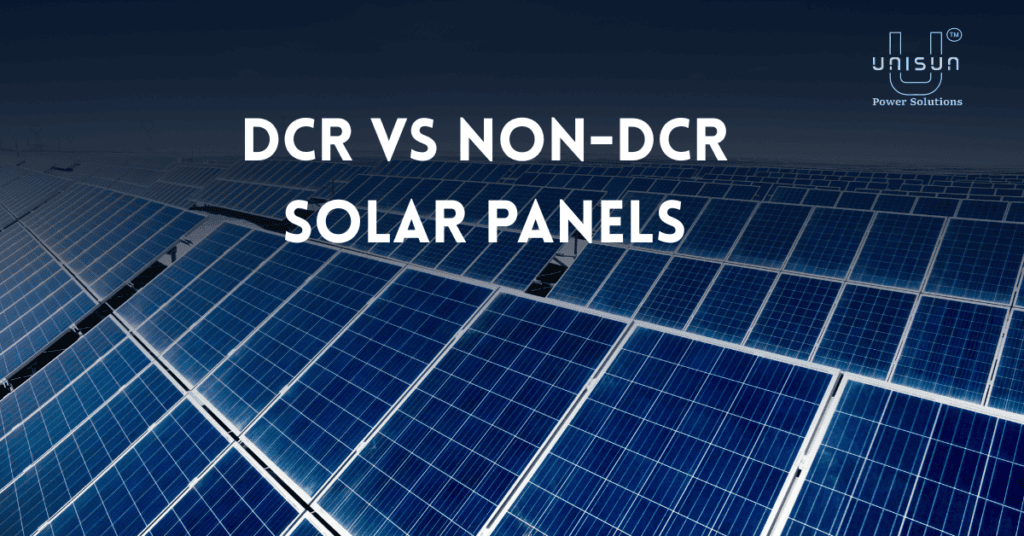
DCR vs Non-DCR Solar Panels: Complete Guide for Solar Buyers
When planning a rooftop or commercial solar installation in India, one of the most common questions is the difference between DCR vs Non-DCR Solar Panels. Although both generate electricity from sunlight, they differ mainly in the origin of their solar cells and manufacturing requirements.
Understanding this difference is essential if you’re applying for the PM Surya Ghar Muft Bijli Yojana, installing a rooftop solar system, or evaluating subsidy eligibility.
This guide explains the meaning of DCR and Non-DCR solar panels, their benefits, costs, subsidy eligibility, ALMM compliance, and which option is best for residential and commercial projects.
What Does DCR Mean in Solar Panels?
DCR stands for Domestic Content Requirement. A DCR solar panel is manufactured using solar cells produced in India and assembled into modules within India according to applicable government requirements.
Indian Manufactured Cells
Solar cells used in DCR panels are manufactured in India.
Made in India Modules
Finished solar modules are assembled by approved Indian manufacturers.
Supports Make in India
Encourages domestic manufacturing and strengthens India’s renewable energy sector.
Energy Security
Reduces dependence on imported solar components.
Employment Growth
Supports manufacturing jobs and local industries.
Government Projects
Commonly required for subsidy-linked solar installations.
What Are Non-DCR Solar Panels?
Non-DCR solar panels are modules that do not satisfy the Domestic Content Requirement. They may use imported solar cells or imported modules while still delivering excellent performance.
Imported Solar Cells
Many Non-DCR panels use cells manufactured outside India.
Advanced Technologies
Available in Mono PERC, TOPCon, bifacial and other premium technologies.
Competitive Pricing
Often available at attractive prices depending on market conditions.
Excellent Efficiency
Performance depends on technology, not DCR status.
Commercial Projects
Suitable for many private commercial and industrial installations.
Global Manufacturers
Available from many internationally recognized solar brands.
Main Difference Between DCR and Non-DCR Solar Panels
The biggest difference is the manufacturing origin of the solar cells and modules—not efficiency or electricity generation.
DCR Solar Panels
- Indian-made solar cells
- Manufactured in India
- Suitable for subsidy projects
- Supports Make in India initiative
- Common in PM Surya Ghar installations
Non-DCR Solar Panels
- Imported cells or imported modules
- Used in private projects
- May not qualify for subsidy
- Available in premium technologies
- Competitive pricing
Are DCR Solar Panels Mandatory for PM Surya Ghar Subsidy?
For residential rooftop installations under the PM Surya Ghar: Muft Bijli Yojana, homeowners must use solar modules that comply with the latest government requirements. Eligible installations generally require DCR-compliant and ALMM-approved solar panels.
1kW System
Eligible subsidy up to ₹30,000.
2kW System
Eligible subsidy up to ₹60,000.
3kW & Above
Maximum subsidy up to ₹78,000.
Vendor Verification
Choose an approved installer registered on the National Portal.
ALMM Compliance
Verify that the selected module appears on the latest ALMM list.
Documentation
Keep invoices, module serial numbers and commissioning records safely.
DCR and ALMM Are Not the Same
Many buyers assume that DCR and ALMM mean the same thing. In reality, they refer to two different compliance requirements.
DCR (Domestic Content Requirement)
- Confirms Indian-manufactured solar cells.
- Supports Make in India.
- Important for subsidy-linked projects.
- Focuses on manufacturing origin.
ALMM (Approved List of Models & Manufacturers)
- Lists approved manufacturers.
- Confirms approved module models.
- Required for many government projects.
- Focuses on approved products.
DCR vs Non-DCR Solar Panel Price
DCR solar panels may cost slightly more because they use domestically manufactured solar cells and must satisfy government compliance requirements. However, eligible homeowners may recover this additional cost through government subsidy benefits.
Module Brand
Pricing varies depending on manufacturer reputation.
Technology
TOPCon, Mono PERC and Bifacial panels influence cost.
Efficiency
Higher efficiency generally increases price.
Warranty
Longer warranties often increase overall value.
Installation
Always compare complete project cost rather than module price alone.
Government Subsidy
Eligible subsidy may significantly reduce total investment.
DCR vs Non-DCR Solar Panel Efficiency
Efficiency depends on the technology used rather than whether a panel is DCR or Non-DCR.
Mono PERC
Widely used high-efficiency solar technology.
TOPCon
Higher efficiency with improved long-term performance.
Bifacial Modules
Generate electricity from both sides of the panel.
Half-Cut Cells
Reduce electrical losses and improve output.
Temperature Performance
Better temperature coefficient means higher generation.
Low Degradation
Premium panels retain output for longer periods.
Advantages of DCR Solar Panels
Government Subsidy
Eligible for subsidy-linked residential rooftop projects.
Supports Indian Manufacturing
Encourages local production and employment.
Energy Security
Reduces dependence on imported components.
Government Projects
Preferred for many public-sector solar installations.
Reliable Support
Local manufacturers often provide faster service.
Future Ready
Complies with evolving government policies.
Limitations of DCR Solar Panels
Higher Initial Cost
Some models may cost more than imported alternatives.
Limited Availability
Certain wattages may not always be available.
Documentation
Requires proper compliance records.
Supply Constraints
Government demand may affect availability.
Technology Choice
Not every technology is available in every brand.
Performance Depends on Quality
DCR status alone does not guarantee higher efficiency.
Advantages of Non-DCR Solar Panels
Competitive Pricing
Often available at attractive market prices.
Advanced Technologies
Premium imported technologies are widely available.
Commercial Projects
Suitable for many private commercial installations.
High Efficiency
Many international brands offer excellent performance.
Wide Selection
Available in numerous wattages and configurations.
Global Brands
Buyers can choose from leading international manufacturers.
Limitations of Non-DCR Solar Panels
No Subsidy Eligibility
Generally not eligible for PM Surya Ghar subsidy where DCR compliance is mandatory.
Import Dependency
Availability and pricing may change because of imports and global supply chains.
Policy Changes
Government regulations regarding imports and ALMM may change over time.
Warranty Support
Warranty claims may take longer depending on the manufacturer.
Compliance Issues
Improper documentation may affect project approvals.
Vendor Verification
Always verify certifications before purchasing imported modules.
Where Are DCR Solar Panels Used?
- PM Surya Ghar Rooftop Projects
- Government Buildings
- Public Schools
- Government Hospitals
- PM-KUSUM Projects
- Subsidy-based Rooftop Installations
- Government Solar Tenders
- Public Infrastructure Projects
DCR panels are primarily used wherever government subsidy or domestic manufacturing compliance is required.
Where Are Non-DCR Solar Panels Used?
- Private Commercial Buildings
- Industrial Rooftop Solar
- Warehouses
- Hotels
- Shopping Malls
- Factories
- Private Ground Mounted Plants
- Non-Subsidized Residential Systems
Non-DCR solar panels are widely used in private commercial and industrial projects where government subsidy is not involved.
Which Solar Panel Is Better?
For Homes
Choose DCR + ALMM approved modules if you plan to claim subsidy.
For Commercial Projects
Compare efficiency, ROI, warranties and project requirements.
For Industries
Select the panel that offers the best long-term performance and compliance.
Explore Our Solar Solutions
Internal Links
Useful Resources
Frequently Asked Questions
1. What is a DCR solar panel?
A DCR solar panel uses solar cells manufactured in India and complies with Domestic Content Requirement guidelines.
2. What is a Non-DCR solar panel?
It is a panel that may use imported cells or imported modules and may not qualify for subsidy-linked projects.
3. Are DCR panels compulsory for PM Surya Ghar?
Yes, eligible residential subsidy projects generally require DCR-compliant modules.
4. Which panel is more efficient?
Efficiency depends on technology such as TOPCon or Mono PERC, not on DCR status.
5. Are DCR panels more expensive?
Sometimes, but subsidy benefits can offset the additional cost.
6. Can Non-DCR panels be used commercially?
Yes, many private commercial and industrial projects use Non-DCR panels.
7. Is ALMM the same as DCR?
No. ALMM and DCR are separate compliance requirements.
8. How can I verify DCR compliance?
Request manufacturer certificates, invoices, serial numbers and ALMM documentation.
9. Which panel is best for homes?
DCR + ALMM approved panels are generally the best choice for subsidy-linked residential installations.
10. Where can I get expert guidance?
Contact COP Energy for professional consultation, installation and subsidy assistance.
Conclusion
Understanding the difference between DCR vs Non-DCR Solar Panels is essential before investing in a rooftop or commercial solar system. While DCR panels support domestic manufacturing and are generally required for subsidy-linked projects, Non-DCR panels remain an excellent choice for many private commercial and industrial applications.
Always compare efficiency, warranty, ALMM approval, subsidy eligibility, manufacturer reputation and installation quality before making a final decision.
At COP Energy, we help homeowners, businesses and industries choose the right solar solution with complete assistance for design, installation, subsidy support and long-term maintenance.