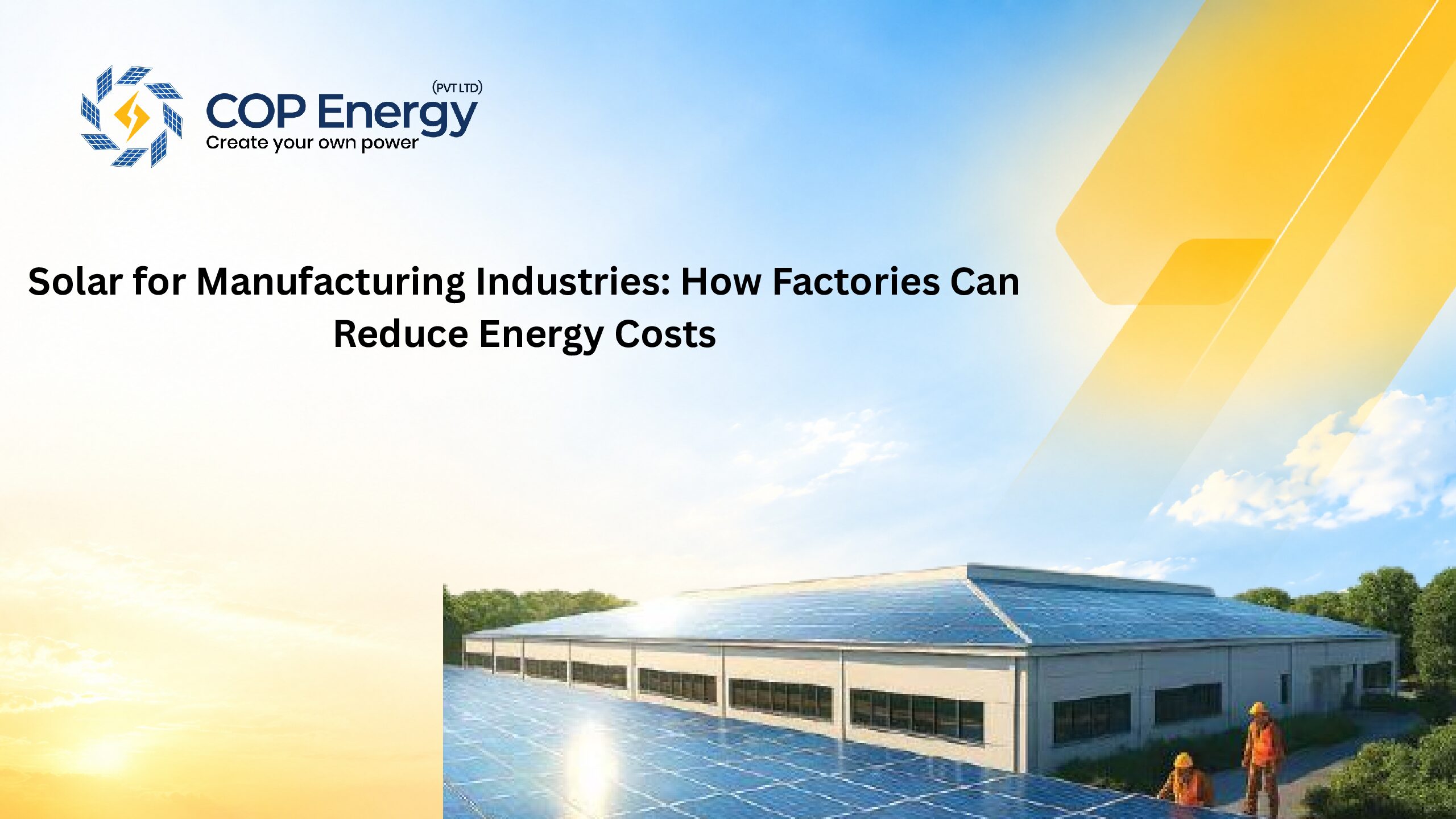
Solar for Manufacturing Industries: How Factories Can Reduce Energy Costs
A practical guide to industrial solar, factory rooftop solar, system sizing, EPC, ROI, O&M and long-term energy management.
For manufacturing businesses, electricity is more than a utility expense. It is an operating input that directly affects production economics.
Factories may run energy-intensive machinery, HVAC systems, compressors, pumps, motors, lighting, process equipment and other electrical loads for long operating hours.
In such environments, even a modest reduction in the effective cost of electricity can have a meaningful impact on operating margins.
This is why solar for manufacturing industries is becoming an important part of industrial energy planning.
A properly designed solar system can help a factory generate electricity from its available roof or land area and reduce its reliance on conventional grid power during suitable operating periods.
India already has a substantial solar base. According to the Ministry of New and Renewable Energy (MNRE) , cumulative solar capacity reached 164.59 GW as of 31 July 2026, including 30.74 GW of grid-connected rooftop solar.
Manufacturers evaluating an industrial solar project can also explore COP Energy’s Industrial Solar Solutions for broader energy-system planning.
1. Start With an Industrial Energy Audit
Before choosing the solar capacity, collect real energy data from the manufacturing facility.
A useful starting dataset includes:
- 12 months of electricity bills
- Connected load
- Maximum demand
- Contracted demand
- Consumption by billing period
- Production hours
- Shift patterns
- Weekend operation
- Seasonal changes
- Existing renewable generation
- Power-quality observations
- Major electrical loads
Where interval data is available, it is even more useful because it reveals when electricity is actually being consumed.
Why This Matters
Suppose a factory has:
High daytime load + high solar availability
This can create strong alignment between solar generation and electricity consumption.
A different facility may have:
Low daytime load + high evening demand
Such a factory may require a different energy strategy, potentially involving battery storage or another configuration.
2. Choose the Right Solar Capacity
The largest possible solar plant is not necessarily the best plant.
System sizing should balance:
Example
A factory consumes substantial electricity during daytime production.
A solar EPC team may evaluate:
- Available roof area
- Structural feasibility
- Solar resource
- Historical consumption
- Self-consumption opportunity
- Electrical interconnection
- Target investment
The objective is to determine a capacity that creates the best technical and economic outcome, not simply the highest possible panel count.
For complete project execution, manufacturers can also review Solar EPC Solutions from COP Energy.
3. Factory Rooftop Solar
Rooftop solar is one of the most visible forms of industrial solar.
Potential advantages include:
- Utilising existing roof space
- Generating electricity close to the point of consumption
- Reducing use of grid electricity during suitable hours
- Avoiding the need for additional land, where rooftop deployment is feasible
However, industrial roofs require detailed assessment before installation.
4. Structural Assessment Before Installation
Structural planning is especially important for industrial facilities.
The engineering team should consider:
- Roof dead load
- Additional PV load
- Mounting system
- Wind loads
- Existing structural condition
- Corrosion
- Roof penetrations
- Maintenance access
Where needed, a qualified structural professional should assess whether reinforcement or other modifications are required.
This assessment should happen before the final solar layout is approved.
5. Understanding Solar ROI for Factories
Solar ROI should be calculated using the actual operating conditions of the manufacturing facility.
Important inputs include:
- Project investment cost
- Expected annual generation
- Factory electricity tariff
- Self-consumption percentage
- Solar degradation assumptions
- Operation and maintenance costs
- Financing costs
- Expected project life
- Applicable export or grid conditions
A project should therefore be evaluated using lifecycle economics rather than looking only at the initial installation cost.
Where the factory has significant evening demand or requires additional resilience, manufacturers can also evaluate Battery Energy Storage Solutions alongside solar.
6. Choosing the Right Solar EPC Partner
Industrial solar projects involve more than installing photovoltaic modules.
An experienced EPC approach should consider:
- Site survey
- Energy analysis
- System design
- Structural assessment
- Electrical engineering
- Equipment selection
- Installation
- Testing and commissioning
- Grid integration
- Performance monitoring
When selecting PV modules, businesses should also consider applicable procurement and eligibility requirements. The MNRE Approved List of Models and Manufacturers (ALMM) can be referenced where applicable.
7. Solar Monitoring and O&M
Installing a solar system is only the beginning of the project’s operating life.
Regular monitoring and maintenance can help identify performance issues and keep the system operating effectively.
O&M activities may include:
- Performance monitoring
- Preventive maintenance
- Module cleaning
- Inverter inspection
- Electrical checks
- Fault identification
- Performance reporting
- Corrective maintenance
Manufacturing companies can consider Solar Monitoring & AMC as part of their long-term solar asset-management strategy.
8. Solar as Part of Industrial Energy Management
Solar should not always be viewed as an isolated generation asset.
For a manufacturing business, it can form part of a broader energy-management strategy.
↓
Solar Assessment
↓
System Design
↓
Economic Analysis
↓
Solar + BESS / EV / Other Energy Assets
↓
Monitoring & Optimisation
Businesses with electric vehicle fleets can also consider integrating EV Charging Infrastructure into their wider energy strategy.
9. Understanding India’s Solar Energy Landscape
India’s renewable-energy sector continues to expand, making solar an increasingly important component of long-term industrial energy planning.
For current official solar-capacity information, manufacturers can refer to the Ministry of New and Renewable Energy’s Physical Progress data .
For electricity-system planning and broader power-sector information, businesses can refer to the Central Electricity Authority (CEA) .
How COP Energy Can Help Manufacturing Industries
COP Energy’s offering covers commercial and industrial solar, solar EPC, battery energy storage, EV charging, solar carports, monitoring and AMC services.
These capabilities can be considered together when developing an industrial energy strategy.
For manufacturing facilities, the objective should be more than installing solar panels.
It should be to build an energy system around the factory’s:
- Load profile
- Production schedule
- Electricity costs
- Available space
- Electrical infrastructure
- Long-term energy goals
Related COP Energy Solutions
- Industrial Solar Solutions
- Commercial Solar Solutions
- Solar EPC Solutions
- Battery Energy Storage Solutions
- Solar Monitoring & AMC
- EV Charging Infrastructure
- Solar Carport Solutions
Frequently Asked Questions
Solar can be suitable for many manufacturing facilities, particularly where electricity consumption is high and there is significant daytime demand. Suitability should be confirmed through a site and energy assessment.
There is no standard capacity for every factory. The appropriate size depends on electricity consumption, demand profile, roof or land availability, structural conditions, solar resource and the project’s commercial objective.
Potentially, subject to structural assessment, roof condition, shading, available area, electrical integration and applicable approvals.
It can reduce electricity purchased from the grid when solar generation offsets site consumption. Actual savings depend on system output, self-consumption, tariff structure and project design.
The choice depends on capital availability, ownership objectives, financing, energy-pricing expectations and the company’s preferred risk profile.
Yes. Solar and BESS can be integrated for applications such as peak shaving, energy shifting and backup, depending on the load profile and commercial case.
The timeline varies by project size, design complexity, approvals, equipment availability, structural work and site conditions.
ROI should be calculated using project-specific investment cost, expected generation, electricity tariff, self-consumption, O&M, financing and other relevant lifecycle assumptions.
Conclusion
Solar for manufacturing industries can be much more than a sustainability initiative.
For the right factory, it can become an important part of a broader strategy for managing electricity costs, improving energy resilience and planning for long-term energy requirements.
The strongest industrial solar projects begin with data.
↓
Assess Your Site
↓
Design the Right System
↓
Model the Economics
↓
Execute Professionally
↓
Monitor Performance
The objective should not be to install the largest possible solar plant.
It should be to design a system that provides the right balance of generation, self-consumption, reliability, lifecycle cost and operational value.
With India’s solar capacity continuing to expand and policy frameworks evolving, manufacturers have increasing opportunities to integrate renewable energy into their long-term strategies. Official capacity information is available through the MNRE solar-capacity data .
Planning Solar for Your Factory?
Evaluate your factory’s electricity consumption, roof or land availability, production schedule and long-term energy requirements before selecting the right solar solution.
Explore COP Energy Solutions