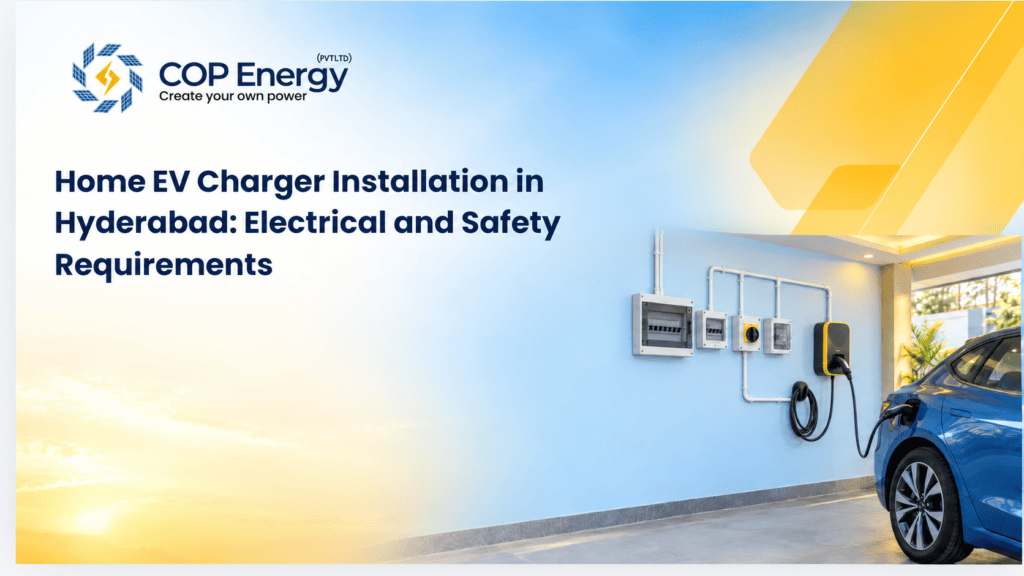
Home EV Charger Installation in Hyderabad: Electrical and Safety Requirements
Electric vehicles are becoming increasingly common across Hyderabad. As more residents switch to electric cars, installing a dedicated EV charger at home offers a convenient way to charge safely without depending entirely on public charging stations.
However, installing a home EV charger involves much more than mounting a charging unit near a parking space. The property’s electrical capacity, wiring, earthing, protective devices, charger compatibility and parking conditions must all be evaluated before installation.
An incorrectly installed charger can overload the electrical system, damage the vehicle or create shock and fire risks. That is why every home EV charger installation in Hyderabad should be planned and executed by a qualified professional in accordance with the charger manufacturer’s specifications and applicable Indian electrical-safety requirements.
What Is a Home EV Charger?
A home EV charger, also known as electric vehicle supply equipment or EVSE, safely delivers electricity from a building’s electrical system to an electric vehicle.
The charger communicates with the vehicle, checks whether a safe connection has been established and regulates the delivery of electricity. The vehicle’s onboard charging system then converts the supplied AC electricity into the DC electricity stored in its battery.
A dedicated EV charger generally offers better safety, control and charging performance than relying on an ordinary household socket for regular charging.
Why Install a Dedicated EV Charger at Home?
Home charging allows an electric vehicle to be charged overnight or whenever it is parked. Its main advantages include:
Convenient charging at your residence
Reduced dependence on public charging stations
Faster charging than many ordinary domestic sockets
Dedicated electrical protection
Scheduled charging during preferred hours
Remote monitoring through supported smart chargers
Better cable organisation and parking-area safety
Potential integration with a rooftop solar system
The actual charging speed depends on the charger capacity, available electrical supply, vehicle battery and the maximum AC power accepted by the vehicle.
Types of Home EV Chargers
Portable EV charger
A portable charger is commonly supplied with an electric vehicle and may connect to a compatible fixed outlet. It can be useful for occasional or emergency charging.
However, a portable charger should not automatically be connected to any existing household socket. The socket, wiring, circuit protection and earthing must be checked for the continuous electrical load involved.
AC wall-mounted charger
An AC wallbox is the most common dedicated home charging solution. Depending on the property and vehicle, typical capacities may include:
3.3 kW
7.4 kW
11 kW
22 kW
A higher charger rating does not always mean the vehicle will charge at that full capacity. Charging is restricted by the lowest-capacity component in the chain: the electrical connection, charger, cable or vehicle’s onboard charger.
For example, connecting an 11 kW wallbox to a car that accepts only 7.4 kW AC charging will not make the car charge at 11 kW.
DC fast charger
DC fast chargers are normally used at commercial or public charging locations. They require significantly higher electrical capacity, specialised equipment and a larger investment. For most Hyderabad homes, a properly selected AC charger is the more practical option.
Electrical Assessment Before Installation
A professional site inspection should be completed before selecting or installing the charger.
1. Available electrical load
The installer should review the property’s sanctioned load and its existing electricity demand. Major household loads may include:
Air conditioners
Water heaters
Induction cooktops
Water pumps
Lifts
Refrigerators
Washing machines
Other high-power appliances
If the house already operates close to its sanctioned load, adding an EV charger could cause frequent breaker trips or overload the electrical installation.
A load enhancement request may be necessary through the applicable electricity distribution company. Requirements can vary according to the connection, property and charger capacity.
2. Single-phase or three-phase supply
Smaller home chargers can commonly operate with a single-phase supply. Higher-capacity AC chargers may require a three-phase connection.
The appropriate option depends on:
The EV model
Maximum onboard AC charging capacity
Desired charging time
Existing power connection
Sanctioned load
Cable route and installation conditions
Future charging requirements
A three-phase supply should not be recommended merely because it supports a larger charger. Charger selection should begin with the vehicle and the household’s actual requirements.
3. Distribution board capacity
The distribution board must have adequate capacity and space for a dedicated EV charging circuit and its protective devices.
The assessment should verify:
Main incomer capacity
Existing circuit loading
Availability of a dedicated outgoing circuit
Condition of the switchboard
Proper neutral and earth arrangements
Coordination between protective devices
Cable termination quality
An old or overcrowded distribution board may need to be upgraded before an EV charger can be installed safely.
4. Dedicated charging circuit
An EV charger should have its own dedicated electrical circuit instead of sharing wiring with household appliances.
India’s Central Electricity Authority requires each EV charging point to be individually supplied through a dedicated sub-circuit protected by a compliant overcurrent protective device. It also requires coordination between the charger’s protective devices. CEA Electrical Safety Regulations, 2023
A dedicated circuit helps:
Prevent overloading of general household circuits
Isolate the charger during maintenance
Improve fault protection
Simplify testing and troubleshooting
Reduce nuisance tripping caused by unrelated appliances
Essential Safety Requirements
Proper earthing
Effective earthing is one of the most important requirements for EV charging. It provides a safe path for fault current and reduces the risk of electric shock.
The earthing arrangement should be tested rather than assumed to be adequate simply because an earth wire is present. The CEA requires earth-continuity monitoring that disconnects the supply if the earthing connection to the vehicle becomes ineffective. It also requires a protective earth conductor between the electricity supply and the vehicle’s conductive parts.
Overcurrent and short-circuit protection
A correctly selected circuit breaker protects the charging cable and equipment against excessive current and short circuits. Its rating must be coordinated with the charger capacity, cable size, installation method, ambient temperature and manufacturer instructions. Installing a larger breaker simply to prevent tripping can leave the wiring dangerously under-protected.
Residual-current protection
A residual-current protective device disconnects the supply when dangerous leakage current is detected. The required RCD type and any DC-leakage detection must match the charger design, applicable standards and manufacturer instructions.
Surge protection
Voltage surges caused by lightning, switching or grid disturbances can damage sensitive charging electronics. A professional installer should assess surge protection and coordinate it with the building’s electrical and lightning protection systems.
Correct cable selection
Cable sizing must consider:
Charging current
Single-phase or three-phase supply
Cable length and voltage drop
Installation inside a conduit or cable tray
Ambient temperature
Grouping with other cables
Indoor or outdoor exposure
Mechanical protection
Undersized cables can overheat during continuous charging. Poor terminations can also create high-resistance points that generate excessive heat.
Safe charger location
The charger should be installed where it can be used without creating a hazard.
A suitable location should:
Be close enough to the vehicle’s charging inlet
Prevent the cable from crossing a walkway or driveway
Protect the equipment against vehicle impact
Provide adequate ventilation
Avoid waterlogging and direct exposure where possible
Allow safe operation and maintenance
Remain accessible without creating a security risk
The CEA regulations specify that a charging-point socket outlet must be installed at least 800 mm above finished ground level. They also limit the charging distance between the charging point and vehicle connection to five metres. CEA Electrical Safety Regulations, 2023
Weather-resistant installation
For outdoor or semi-covered parking, the charger enclosure and electrical accessories must be suitable for the environmental conditions.
The installer should consider:
Rain and water splashes
Dust
High summer temperatures
Direct sunlight
Humidity
Drainage
Pest or rodent damage
The required ingress-protection rating should be selected according to the installation location and manufacturer recommendations.
No extension boards or unauthorised adaptors
Extension boards and ordinary multi-plug adaptors should never be used for routine EV charging.
CEA regulations prohibit using a cord extension set or additional supply lead between the vehicle and charging point. They also prohibit adaptors between the vehicle connector and vehicle inlet and do not permit portable socket outlets for EV charging. CEA Electrical Safety Regulations, 2023
Home EV Charger Installation Process
Step 1: Understand the vehicle requirements
Check the vehicle manufacturer’s specifications, including:
AC charging capacity
Recommended charger rating
Connector type
Cable requirements
Earthing requirements
Smart-charging compatibility
Warranty conditions
Step 2: Conduct a site and load assessment
A qualified installer should inspect the electrical panel, sanctioned load, wiring, earthing and parking location.
Step 3: Select the appropriate charger
Choose a charger that is compatible with the vehicle and relevant Indian standards. The IS 17017 series covers electric-vehicle conductive charging systems, while AIS-138 addresses performance and safety requirements for AC and DC charging equipment under Indian conditions. CEA EV Charging Standards
Useful charger features may include:
Scheduled charging
Mobile-app monitoring
Access control
Energy-consumption reports
Dynamic load management
Solar-surplus charging
Automatic fault detection
Remote support
Step 4: Obtain necessary permissions
Independent-home installations are generally simpler, but load enhancement or supply modification may require coordination with the relevant DISCOM.
For an apartment or gated community, approval may also be required from the resident welfare association, facilities team or property owner. The approval process should address the cable route, parking ownership, common-area electrical supply, electricity metering and fire-safety arrangements.
Step 5: Install the dedicated circuit
The installer should route the correctly rated cable from the electrical panel to the charging point and provide the required isolation, overcurrent, residual-current, surge and earthing protection.
Step 6: Test and commission the charger
Installation is not complete until the circuit and charger have been tested.
Testing should cover applicable items such as:
Supply voltage
Polarity and phase sequence
Earth continuity
Insulation resistance
Protective-device operation
RCD operation
Charger–vehicle communication
Charging under load
Emergency isolation
Cable and terminal heating
The CEA requires owners to ensure that tests specified by the charger manufacturer for the charging station and residual-current devices are performed. It also requires inspection and testing records to be maintained. CEA Electrical Safety Regulations, 2023
Installing an EV Charger in a Hyderabad Apartment
Apartment charging can require additional planning because the parking area and electrical infrastructure may be shared.
Before installation, confirm:
Whether the parking space is allotted to the resident
Whether the charger can connect to the flat’s meter
Whether a separate or common-area meter is required
Who will pay for consumed electricity
Whether the existing transformer and common panel have sufficient capacity
How the cable will be safely routed
Whether load management is required
What society or builder approvals are necessary
Who will maintain the charger and protection system
Where multiple residents require chargers, a coordinated EV charging plan is generally better than installing separate, unplanned circuits one at a time.
Can a Home EV Charger Be Integrated With Solar?
Yes, a home EV charger may be integrated with a rooftop solar system, subject to system design and equipment compatibility.
A solar-compatible smart charger can potentially:
Prioritise available solar power
Schedule charging during solar-generation hours
Monitor grid and solar consumption
Reduce reliance on grid electricity
Coordinate charging with other household loads
However, solar panels do not necessarily provide uninterrupted EV charging. Solar generation varies with weather and time of day. Battery storage or grid electricity may still be needed depending on when and how the vehicle is charged.
A combined solar and EV charging system should be designed after studying the home’s electricity consumption, solar capacity, EV usage and available connection load.
For compatible renewable-energy and storage options, explore COP Energy’s solar, battery and EV charging solutions.
Home EV Charger Maintenance Tips
After installation:
- Inspect the cable and connector regularly.
- Keep the connector clean and dry.
- Stop using damaged or unusually hot charging equipment.
- Keep the charging area free from standing water.
- Test protective devices according to manufacturer instructions.
- Arrange periodic professional inspection.
- Install charger firmware updates where supported.
Do not open or repair the charger yourself. Contact the authorised service provider or a qualified electrical professional.
Frequently Asked Questions
1. What capacity home EV charger should I install?
The correct capacity depends on the vehicle’s maximum AC charging rate, daily travel, available charging time, sanctioned load and electrical supply. A professional assessment should be completed before choosing the charger.
2. Can I charge my electric car using a normal household socket?
Some vehicles include a portable charger, but the outlet and its circuit must be suitable for continuous charging and meet the vehicle manufacturer’s requirements. A dedicated wallbox with proper protection is generally preferable for regular charging.
3. Does a home EV charger require three-phase power?
Not always. Many lower-capacity chargers operate on single-phase power. Higher-capacity chargers may require three-phase power, but the car’s onboard charger must also support that charging capacity.
4. Is separate earthing required for an EV charger?
The charging system requires effective, tested earthing and earth-continuity protection. Whether a separate electrode is required depends on the existing installation, applicable design standards and manufacturer instructions. It should be determined by a qualified professional.
5. Do I need DISCOM approval?
Approval may be required if the installation needs a sanctioned-load increase, new connection, metering change or supply modification. Confirm the requirements with the relevant electricity distribution company before installation.
6. Can I install an EV charger in an apartment parking space?
Yes, subject to technical feasibility and necessary approvals. Cable routing, common-area usage, metering, electrical capacity and fire safety should be agreed upon with the apartment association or facilities team.
7. How long does home EV charging take?
Charging time depends on battery size, current state of charge, charger output and the vehicle’s maximum accepted charging rate. Dividing usable battery energy by effective charging power gives a rough estimate, but actual charging may take longer because charging speed is not always constant.
8. Can I install the charger myself?
EV charger installation should be completed by a qualified installer or licensed electrical professional. Incorrect wiring, earthing or circuit protection can result in shock, overheating, equipment damage or fire.
9. Can rooftop solar charge my electric vehicle?
Yes. A correctly designed solar and EV charging system can use available solar generation to charge the vehicle. Actual solar contribution depends on system capacity, generation conditions and charging time.
10. What should I do if the charger becomes unusually hot?
Stop charging safely, isolate the circuit if appropriate and contact the installer or authorised service provider. Do not continue using equipment showing excessive heat, burning smells, damaged cables or repeated protective-device trips.
Conclusion
A home EV charger makes electric-vehicle ownership more convenient, but safety must remain the first priority. The right installation begins with understanding the vehicle’s charging capacity and evaluating the home’s sanctioned load, distribution board, wiring, earthing and parking conditions.
A dedicated circuit, coordinated protective devices, tested earthing, appropriate cables and professional commissioning are essential for safe and dependable charging.
If you are planning a home EV charger installation in Hyderabad, arrange a professional site assessment before purchasing the charger. COP Energy can evaluate your electrical infrastructure, charging requirements and opportunities for integrating EV charging with rooftop solar or battery storage. Review our energy solutions, explore completed projects or contact COP Energy to discuss your site.
Technical note: This article provides general information. Final equipment selection and installation must follow applicable regulations, local DISCOM requirements, vehicle and charger manufacturer instructions, and a site-specific assessment by a qualified electrical professional.
Plan Your Home EV Charger Installation
Discuss your vehicle, sanctioned load, parking location and solar-integration requirements with COP Energy.