Lithium-Ion vs Lead-Acid Solar Battery: Complete Guide for Solar Buyers
Solar panels generate electricity when sunlight is available. However, homes and businesses often need electricity during the evening, at night or during a grid outage. This is where a solar battery storage system becomes valuable.
A solar battery stores surplus electricity generated by solar panels and makes it available when solar generation is low or unavailable. The two commonly considered options are lithium-ion batteries and lead-acid batteries.
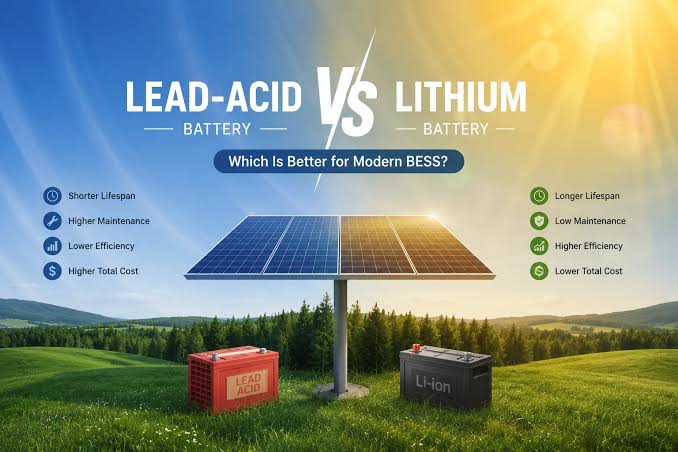
In the lithium-ion vs lead-acid solar battery comparison, lithium-ion batteries generally provide higher usable capacity, longer cycle life, faster charging, better energy efficiency, lower maintenance and a smaller size with lower weight. Lead-acid batteries, on the other hand, usually have a lower initial purchase price and remain useful for budget-sensitive installations or systems used only occasionally.
The right choice depends on the required backup duration, daily usage, installation space, budget, inverter compatibility and expected return on investment. Solar-plus-storage systems allow electricity generated during sunny hours to be stored and used later, helping balance generation and demand — the U.S. Department of Energy identifies lithium-ion as one of the important technologies used for this purpose.
What Is a Lithium-Ion Solar Battery?
A lithium-ion solar battery is a rechargeable energy-storage device that moves lithium ions between its electrodes during charging and discharging. Several lithium-ion chemistries exist, and one of the most common used in stationary solar storage is lithium iron phosphate (LFP).
Rechargeable Chemistry
Stores and releases energy by moving lithium ions between electrodes.
LFP Chemistry
Lithium iron phosphate is widely used for stationary solar storage.
Compact Design
Stores more energy relative to size and weight than older technologies.
Fast Charging
Recharges quickly compared with conventional battery chemistries.
Long Cycle Life
Designed to withstand frequent daily charge-discharge cycles.
Smart Monitoring
Typically pairs with a battery management system and remote monitoring.
What Is a Lead-Acid Solar Battery?
A lead-acid solar battery uses lead-based electrodes and a sulphuric-acid electrolyte to store and release electricity. Lead-acid battery technology has been used for many decades and remains common in home inverter systems, UPS systems, off-grid solar installations, telecom backup systems, emergency power systems and automotive applications.
Flooded Lead-Acid
Contains liquid electrolyte; may require water topping, ventilation, terminal cleaning and regular inspection.
Tubular Lead-Acid
Widely used for home inverter and solar-backup applications in India; handles deeper discharge than automotive batteries.
Sealed Lead-Acid
Includes AGM, gel and VRLA types; generally lower maintenance but limited usable capacity and cycle life.
Decades of Use
An established, well-understood technology across many backup applications.
Correct Charging Needed
Even low-maintenance sealed types require correct charging profiles.
Wide Familiarity
Commonly available with established local service and replacement channels.
Main Difference Between Lithium-Ion and Lead-Acid Solar Batteries
The most important differences are not limited to purchase price. Solar buyers should compare the batteries using usable energy, depth of discharge, cycle life, round-trip efficiency, charging speed, weight, installation space, maintenance, warranty, safety, replacement cost and lifetime cost.
A lead-acid battery may appear cheaper at the time of purchase. However, a lithium-ion battery may provide more usable energy per cycle and require fewer replacements over the life of the solar system. Therefore, the correct comparison is total cost of ownership, not merely upfront battery price.
Lithium-Ion Solar Battery
- Higher usable capacity
- Longer cycle life
- Faster charging
- Better energy efficiency
- Lower maintenance, smaller size
Lead-Acid Solar Battery
- Lower initial purchase price
- Suits infrequent backup use
- Established replacement channels
- Requires more installation space
- Needs regular maintenance
What Is Depth of Discharge?
Depth of discharge, or DoD, indicates how much of a battery’s rated capacity has been used. For example, consider a battery rated at 10kWh: at 50% DoD, approximately 5kWh has been used; at 80% DoD, approximately 8kWh has been used; at 90% DoD, approximately 9kWh has been used.
Lead-acid batteries are often operated at a more conservative depth of discharge to protect their useful life. Modern lithium-ion batteries may allow a much greater percentage of their rated capacity to be used, subject to the manufacturer’s operating limits. This means a smaller lithium battery can sometimes deliver usable energy comparable to a larger lead-acid battery bank.
Example: Assume a home requires 8kWh of usable backup. If the design allows 50% usable capacity from a lead-acid bank and 90% usable capacity from a lithium battery, the approximate nominal battery capacity required would be:
| Battery Technology | Approximate Rated Capacity Required |
|---|---|
| Lead-acid | 16kWh |
| Lithium-ion | 8.9kWh |
This is a simplified illustration. Actual sizing must account for inverter losses, temperature, discharge rate, ageing and backup reserve.
Size and Weight Comparison
Lithium-ion batteries store more energy relative to their physical size and weight. As a result, they are valuable for space-constrained and weight-sensitive installations. Lead-acid battery banks are significantly heavier and may require reinforced flooring, larger racks, greater ventilation, more installation space and additional handling equipment. For large solar-backup requirements, the size difference can become substantial.
Apartments & Villas
Compact lithium batteries suit limited electrical rooms.
Wall-Mounted Systems
Lightweight designs allow flexible mounting options.
Commercial Facilities
Ideal where floor area is limited.
Solar Carports
Compact storage fits within carport structures.
EV-Charging Sites
Space-efficient storage supports charging infrastructure.
Lead-Acid Banks
Need reinforced flooring, racks and greater ventilation.
Lithium-Ion vs Lead-Acid Solar Battery Cost
Lead-acid batteries generally cost less initially. Lithium-ion batteries usually involve a higher upfront investment because of advanced cell chemistry, integrated battery management systems, higher usable capacity, longer cycle life, compact packaging, thermal and electrical protection, communication features and system monitoring.
However, initial cost does not provide the complete picture. A lifetime-cost comparison should consider purchase price, usable battery capacity, number of expected cycles, replacement frequency, charging efficiency, maintenance expense, installation space, downtime, warranty coverage and recycling and disposal cost. NREL’s System Advisor Model uses the levelised cost of storage to compare the complete cost of owning and operating storage technologies, including charging, replacement, augmentation, operation and maintenance.
Which Battery Is Best for a Hybrid Solar System?
A hybrid solar system combines solar panels, a grid connection, a hybrid inverter, battery storage and energy-management controls. Lithium-ion batteries are generally well suited to hybrid solar systems because of their fast response, high efficiency, high usable capacity, compact design, communication with compatible inverters and ability to handle frequent charge-discharge cycles.
The battery and hybrid inverter must have compatible voltage, current, communication protocol, BMS interface, charging profile, firmware and power rating. A battery should never be connected to an inverter merely because the nominal voltage appears to match.
Solar Battery Safety Comparison
Both technologies require proper installation and handling.
Lithium-Ion Battery Safety
Lithium-ion batteries can pose a fire risk if physically damaged, overcharged, short-circuited, exposed to excessive heat, improperly manufactured, installed without suitable protection, used with an incompatible inverter, or improperly discarded. The EPA notes that lithium-ion batteries are generally safe when sourced from reliable manufacturers and used correctly, but damaged or improperly managed batteries can catch fire or explode.
- Integrated BMS and appropriate enclosure
- Overcurrent protection and correct cable sizing
- Temperature monitoring and ventilation clearance
- Professional commissioning
Lead-Acid Battery Safety
Lead-acid batteries can present risks including acid leakage, corrosive exposure, hydrogen gas accumulation, electrical short circuit, heavy lifting injuries, terminal corrosion and explosion from ignition near accumulated gas.
- Install in a well-ventilated area
- Keep away from flames and sparks
- Avoid occupied living spaces
- Regular terminal and electrolyte checks
Temperature Performance
Battery performance and life are strongly influenced by temperature. For lithium-ion batteries, excessive heat can accelerate ageing and shorten service life, while cold conditions may reduce charging and discharging performance, although extreme cold is less common in Hyderabad. For lead-acid batteries, high temperatures can accelerate water loss, grid corrosion, self-discharge and battery degradation.
Both battery types should be installed in a shaded, ventilated and manufacturer-approved location. Installing batteries directly under intense rooftop sunlight or near heat-producing equipment can significantly affect performance.
Recycling and Environmental Considerations
Both lithium-ion and lead-acid batteries require controlled end-of-life handling. Lead-acid batteries have an established recycling network in many markets — the EPA describes the lead-acid collection system as a long-running example of circularity and reports that lead-acid batteries are among the most widely recycled products in the United States. However, informal or poorly controlled recycling can expose workers and communities to toxic lead and acid.
Lithium-ion batteries contain valuable materials that may include lithium, copper, aluminium, nickel, cobalt, manganese and graphite. Recycling can recover useful materials and reduce demand for newly mined resources. The EPA explains that used lithium-ion batteries should be taken to specialised collection or recycling facilities rather than placed in ordinary rubbish or municipal recycling bins. For medium- and large-scale energy-storage batteries, end-of-life management should be coordinated with the manufacturer, supplier or installation company.
Lithium-Ion vs Lead-Acid for Residential Solar
Choose Lithium-Ion When:
- The battery will be used every day
- Long backup duration is required
- Installation space is limited
- Low maintenance is important
- Fast charging is needed
- A hybrid inverter is being installed
- Long-term ownership cost matters
- Remote monitoring is required
Consider Lead-Acid When:
- The initial budget is the main constraint
- Backup use is infrequent
- Adequate space and ventilation are available
- Maintenance can be performed regularly
- The expected system life is relatively short
- The property already has a compatible inverter
Lithium-Ion vs Lead-Acid for Commercial Solar
Commercial and industrial facilities often require storage for peak shaving, demand management, backup power, solar self-consumption, power-quality support, critical-load operation, EV charging and energy arbitrage. Lithium-ion BESS solutions are usually more suitable for these applications because they provide faster response, higher power capability, automated controls, remote monitoring, compact installation, frequent cycling and scalable modular design.
NREL’s System Advisor Model supports the analysis of lithium-ion and lead-acid storage for both behind-the-meter and front-of-meter applications, including peak shaving and responses to time-varying electricity prices.
Can a Solar Battery Replace a Diesel Generator?
A properly designed battery system can reduce diesel-generator use and may provide backup for selected loads. However, replacing a generator completely depends on load size, backup duration, motor-starting current, battery capacity, inverter power, solar availability, grid reliability, critical-load requirements and redundancy needs.
Typically Supportable Loads
- Lighting and fans
- Computers
- Refrigerators
- Security systems
- Communications equipment
Loads Needing Greater Capacity
- Central air conditioning
- Elevators
- Industrial motors and compressors
- Pumps
- Heating loads
A proper load study must be completed before claiming that a battery can replace a generator.
How to Calculate the Required Solar Battery Size
Start by listing the appliances that must run during an outage.
Assume the critical load is 1,000 watts and the required backup is five hours:
1,000W × 5 hours = 5,000Wh, or 5kWh
The battery should then be adjusted for allowed depth of discharge, inverter efficiency, battery ageing, temperature and emergency reserve.
Simplified example: Assume required usable energy of 5kWh, inverter efficiency of 90%, and lithium battery usable capacity of 90%.
A practical design may therefore select a battery of approximately 6.5kWh or more. Battery sizing should be completed by a qualified system designer.
Questions to Ask Before Buying a Solar Battery
- What is the battery chemistry?
- What is the rated energy capacity?
- What is the usable energy capacity?
- What depth of discharge is permitted?
- What is the cycle-life rating?
- Under what test conditions was cycle life measured?
- What is the round-trip efficiency?
- What is the continuous output power?
- What is the peak output power?
- Is a BMS included?
- Is the battery compatible with my inverter?
- What communication protocol is used?
- What is the operating-temperature range?
- What is the product warranty?
- Is the warranty based on years, cycles or energy throughput?
- Who provides service in Hyderabad?
- How will the battery be recycled?
- What fire and electrical protections are included?
- Can the battery capacity be expanded later?
- Does the system include remote monitoring?
Common Solar Battery Buying Mistakes
Comparing Only Ah Ratings
Ampere-hour capacity cannot be compared properly without considering battery voltage. A 100Ah, 12V battery and a 100Ah, 48V battery store very different amounts of energy.
Ignoring Usable Capacity
Rated capacity is not always fully usable.
Selecting an Incompatible Inverter
Battery voltage alone does not guarantee compatibility.
Buying Without a Load Calculation
An undersized battery produces disappointing backup time.
Ignoring Peak Power
A battery may have sufficient energy capacity but still be unable to start a large motor or air conditioner.
Choosing by Price Alone
A cheaper battery may require more replacements and maintenance.
Ignoring Warranty Conditions
Some warranties limit maximum cycles, depth of discharge, energy throughput, temperature, installation location or approved inverter models.
Installing in Excessive Heat
High temperatures reduce battery life.
Improper Disposal
Both lead-acid and lithium-ion batteries require specialised recycling.
Common Myths About Lithium and Lead-Acid Batteries
Myth 1: Lead-acid batteries are always cheaper
They are usually cheaper initially, but they may not be cheaper over the full system life.
Myth 2: Lithium batteries never require maintenance
They require less routine maintenance, but system inspection, software monitoring and safe operating conditions remain necessary.
Myth 3: Every lithium battery lasts ten years
Battery life depends on chemistry, temperature, cycles, depth of discharge and quality.
Myth 4: Lithium batteries are always unsafe
Certified, properly engineered lithium batteries from reliable manufacturers are generally safe when installed and operated correctly.
Myth 5: Lead-acid batteries can always be discharged completely
Repeated deep discharge can substantially reduce lead-acid battery life.
Myth 6: A larger Ah number always means more backup
Voltage and usable depth of discharge must also be considered.
Myth 7: Any solar inverter can work with any battery
Battery and inverter compatibility must be confirmed by the manufacturers.
Lithium-Ion vs Lead-Acid Solar Battery: Which One Should You Choose?
Choose Lithium-Ion When Your Priorities Are:
- Daily cycling
- Long service life
- High usable capacity
- Fast charging and high efficiency
- Compact size, low maintenance
- Smart monitoring
- Commercial energy management
- Long-term value
Choose Lead-Acid When Your Priorities Are:
- Low initial cost
- Occasional backup
- Simple inverter applications
- Easy local availability
- Established replacement channels
- Adequate installation space
For most new hybrid solar installations designed for daily use, a quality lithium iron phosphate battery is generally the stronger long-term option. For a budget-limited system intended mainly for occasional emergency backup, a properly sized lead-acid battery can still be suitable.
COP Energy positions battery storage as part of its integrated solar, storage and EV-charging offering for backup, peak shaving and energy optimisation.
Explore Our Solar Solutions
Internal Links
- Residential Solar Solutions
- Commercial and Industrial Solar Solutions
- Battery Energy Storage Systems
- Hybrid Solar System Solutions
- Solar Panel Installation in Hyderabad
- Solar Carport Solutions
- EV Charging Infrastructure
- Solar Maintenance Services
- On-Grid vs Off-Grid vs Hybrid Solar
- 3kW Solar System Price in Hyderabad
- Contact COP Energy
Please confirm these internal URL paths in the COP Energy CMS before publication.
Useful Resources
- U.S. Department of Energy: Solar-Plus-Storage 101
- U.S. Department of Energy: Solar Energy and Storage Basics
- NREL System Advisor Model: Battery Storage
- U.S. EPA: Lithium-Ion Battery Recycling
- U.S. EPA: Used Lithium-Ion Batteries
- IRENA: Electricity Storage and Renewables
- IRENA: 24/7 Renewables and Battery Storage
Frequently Asked Questions
1. Which battery is better for solar: lithium-ion or lead-acid?
Lithium-ion is generally better for daily solar cycling, longer life, faster charging, high usable capacity and low maintenance. Lead-acid is more suitable where the upfront budget is limited and backup use is infrequent.
2. Does a lithium solar battery last longer than lead-acid?
A quality lithium battery normally provides a greater number of charge-discharge cycles than a lead-acid battery. Actual life depends on temperature, depth of discharge, usage and battery quality.
3. Why are lithium solar batteries more expensive?
They contain advanced cells, electronic battery-management systems and protection controls. They also generally provide greater usable capacity and longer cycle life.
4. Can I replace a lead-acid battery with lithium?
Possibly, but inverter and charger compatibility must be verified. Charging voltage, communication, current limits and BMS requirements may differ.
5. Which lithium chemistry is best for solar?
Lithium iron phosphate, or LFP, is widely used for stationary solar storage because of its cycle life and thermal stability.
6. Is a lithium-ion battery safe for home solar?
A certified battery from a reliable manufacturer can be safe when installed by qualified professionals with a compatible inverter and suitable electrical protection.
7. How much battery capacity is needed for a home?
The answer depends on critical appliance load, required backup duration, depth of discharge, inverter efficiency and solar generation.
8. Can a lead-acid battery be used every day?
It can be used daily, but frequent deep discharge may shorten its life. The system must be designed around the manufacturer’s recommended depth of discharge.
9. Does a solar battery qualify for the PM Surya Ghar subsidy?
The standard residential subsidy is primarily based on eligible grid-connected rooftop solar capacity. Battery-storage costs are generally not treated the same as subsidised rooftop PV capacity. Applicants should verify the current rules on the official portal before purchase.
10. Can a lithium battery run an air conditioner?
It can, provided the battery and inverter have sufficient continuous power, peak power and energy capacity. A professional load calculation is essential.
11. Which battery requires less space?
Lithium-ion batteries generally require much less space for the same usable energy.
12. Which battery is more environmentally friendly?
The answer depends on manufacturing, lifespan, efficiency, electricity source and recycling. Both technologies should be returned through approved recycling or take-back channels.
Conclusion
The lithium-ion vs lead-acid solar battery decision should be based on more than the initial price. Lithium-ion batteries generally offer longer cycle life, higher usable capacity, faster charging, better efficiency, lower maintenance, lower weight, compact installation and better suitability for daily cycling.
Lead-acid batteries remain a practical, lower-cost option for budget-sensitive systems with adequate space, ventilation and regular maintenance, especially where backup use is occasional rather than daily.
At COP Energy, we help homeowners, businesses and industries choose the right battery storage solution with complete assistance for system design, installation, inverter compatibility and long-term maintenance.
Contact COP Energy for a personalised solar battery recommendation.