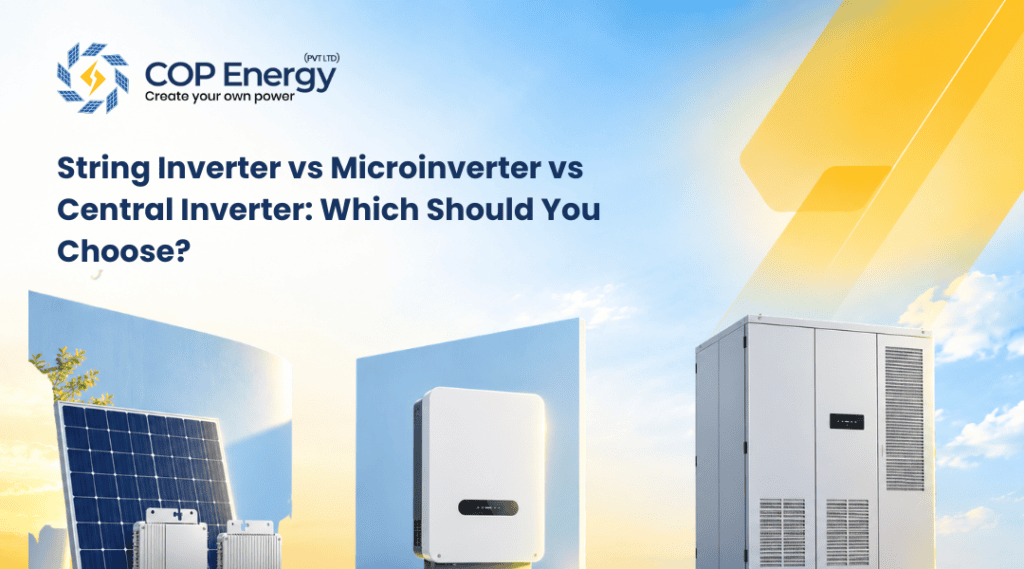
String Inverter vs Microinverter vs Central Inverter: Which Should You Choose?
The inverter is one of the most important components of a solar power system. Solar panels produce direct-current electricity, while homes, businesses and the electrical grid generally use alternating-current electricity. The inverter converts the DC power generated by the solar panels into usable AC power.
However, not every solar installation uses the same inverter architecture. The three major options are:
String inverters
Microinverters
Central inverters
Each technology has its own advantages, limitations and suitable applications. A microinverter may work well on a small, shaded residential roof, while a central inverter may be more appropriate for a large, uniform solar plant. String inverters sit between these two options and are widely used across residential, commercial and increasingly large-scale installations.
The right choice depends on system capacity, roof layout, shading, monitoring requirements, maintenance strategy, expansion plans and budget.
What Does a Solar Inverter Do?
A solar inverter performs more functions than basic DC-to-AC conversion. Depending on its design, it may also:
Track the maximum available power from solar panels
Synchronise the solar system with the electrical grid
Monitor voltage, current and energy generation
Detect abnormal operating conditions
Disconnect the system during a grid outage
Provide system-performance data
Support voltage and reactive-power control
Communicate with monitoring platforms
Manage batteries in compatible hybrid systems
The U.S. Department of Energy explains that modern inverters can support grid functions in addition to converting solar-generated DC electricity into AC electricity. U.S. Department of Energy
What Is a String Inverter?
In a string-inverter system, multiple solar panels are connected in series to form a string. One or more strings are then connected to a string inverter.
The string inverter converts the combined DC electricity from the connected solar panels into AC electricity.
For example, a rooftop solar system containing 20 panels might be divided into two strings of 10 panels. Both strings could connect to a single inverter with multiple Maximum Power Point Tracking inputs.
Advantages of string inverters
Lower initial equipment cost
String inverters are generally economical for residential and commercial projects with straightforward layouts. One inverter can manage multiple solar panels, reducing the number of power-electronic devices required.
Easier ground-level maintenance
A string inverter is normally installed on a wall or in an accessible service area. Technicians can inspect, test or replace it without removing solar panels.
Simple system architecture
String systems have fewer inverter units and communication devices than microinverter systems. This can simplify installation, monitoring and maintenance.
Suitable for many project sizes
String inverters are available in a wide range of capacities. They can be used for small rooftop systems, commercial buildings and large solar projects employing multiple three-phase string inverters.
Multiple MPPT inputs
Modern string inverters can include several MPPT channels. Different roof orientations or module groups can be connected to separate trackers, helping reduce mismatch between arrays.
Limitations of string inverters
Shading and mismatch sensitivity
If modules connected within the same operating string experience different conditions, shading, dirt, orientation or module mismatch can affect string performance.
The actual impact depends on string design, inverter MPPT configuration, module bypass diodes and shading pattern. It is therefore not accurate to assume that one shaded panel always stops the entire string, but shading can reduce overall string production.
Limited module-level monitoring
Standard string inverters may provide inverter-level or string-level information rather than data for every panel. Module-level monitoring may require additional power optimisers or monitoring equipment.
Single point of failure
If a residential system has one string inverter and that inverter stops operating, the connected system may stop producing electricity until the fault is resolved.
What Is a Microinverter?
A microinverter is a compact inverter installed at or near each solar panel. Instead of sending combined DC electricity from several panels to one inverter, every module converts its own DC output into AC electricity.
The U.S. Department of Energy notes that microinverters allow panels to operate independently, which can be useful where some modules experience shading. Solar PV System Design Basics
Advantages of microinverters
Independent panel operation
Each module has its own inverter and maximum-power-point tracking. A shaded or underperforming panel is less likely to directly restrict the operation of other panels.
This makes microinverters useful for:
Complex roof layouts
Multiple roof orientations
Partial shading
Small arrays distributed across different roof sections
Systems where modules receive different sunlight levels
Module-level monitoring
Microinverter systems commonly provide generation data for individual solar panels. This helps identify a specific panel or inverter that is underperforming.
Easier modular expansion
Additional panels can sometimes be added more easily because each new panel has its own microinverter. Expansion still depends on cable capacity, branch-circuit limits, grid approvals and equipment compatibility.
Reduced high-voltage DC distribution
DC electricity is converted to AC at the module. This reduces the need for long, high-voltage DC cable runs across the roof.
No single system-wide inverter failure
If one microinverter fails, other modules can usually continue generating electricity. Only the associated panel’s output is affected.
Limitations of microinverters
Higher initial cost
One microinverter is required for each panel, along with compatible cabling, communication and monitoring equipment. The initial cost may therefore be higher than that of a conventional string-inverter system.
More rooftop electronic components
Every solar panel has a power-electronic device exposed to rooftop temperatures and environmental conditions. Although the devices are designed for outdoor use, the system contains more individual components.
Roof access for repairs
If a microinverter fails, technicians may need to access the roof and remove or lift the associated solar panel. Maintenance can be more difficult on steep, fragile or inaccessible roofs.
Not always economical for large systems
Using a separate microinverter on every module may not be financially or operationally attractive for large commercial and utility-scale projects.
What Is a Central Inverter?
A central inverter is a large inverter that receives DC electricity from many solar-panel strings. Multiple strings are usually combined through DC combiner equipment before reaching the inverter.
Central inverters are traditionally associated with:
Utility-scale solar plants
Large ground-mounted systems
Large industrial solar installations
Sites with extensive, uniform arrays
The Department of Energy describes central inverters as an architecture commonly used in large-scale utility or mid-scale community solar projects. U.S. Department of Energy
Advantages of central inverters
Suitable for large capacities
One central inverter can handle a significant amount of solar capacity, making it suitable for large and relatively uniform solar fields.
Lower inverter cost per unit of capacity
At scale, centralised equipment can reduce the number of individual inverter units and may offer a competitive equipment cost per watt.
Centralised maintenance location
The primary conversion equipment is located in a central station or designated electrical area. Technicians do not need to visit many inverter locations for routine central-inverter work.
Simplified fleet-level control
Large projects can integrate the central inverter with SCADA, plant controllers and grid-management systems.
Limitations of central inverters
Large single point of failure
When a central inverter is unavailable, a substantial portion of the solar plant can stop generating. Redundancy, spares and a strong maintenance plan are therefore important.
Lower flexibility for irregular layouts
Central inverters generally work best with large, uniform arrays. They may be less suitable for roofs with multiple orientations, different panel types or significant localised shading.
Long DC cable runs
Large centralised systems may require extensive DC cabling, combiner boxes and protection equipment between the solar arrays and inverter.
Specialised maintenance
Central inverters can require trained personnel, specialised spare parts and more complex repair procedures.
Difficult future expansion
Expanding a central-inverter plant requires careful evaluation of available input capacity, the DC-to-AC ratio, combiner capacity, transformers and grid infrastructure.
String Inverter vs Microinverter vs Central Inverter
| Factor | String inverter | Microinverter | Central inverter |
|---|---|---|---|
| Typical use | Homes and commercial rooftops | Homes and small complex rooftops | Large industrial and utility projects |
| Conversion level | One inverter for one or more strings | One inverter at each panel | One large inverter for many strings |
| Shading response | Depends on string and MPPT design | Strong module-level independence | Best with uniform, minimally shaded arrays |
| Monitoring | Inverter or string level | Individual panel level | Plant or inverter level |
| Initial cost | Generally moderate | Generally higher per watt | Economical at large scale |
| Maintenance access | Usually accessible from ground | Often requires roof access | Centralised but specialised |
| Failure impact | Affects connected strings | Usually affects one panel | Can affect a large plant section |
| Expansion flexibility | Moderate | Often relatively flexible | Requires detailed engineering |
| DC cabling | Moderate | Fewer long high-voltage DC runs | Extensive DC collection |
For professional system design, review COP Energy’s solar solutions.
Which Inverter Performs Better Under Shading?
Microinverters usually offer the greatest module-level independence. Each solar panel operates using its own MPPT, so the remaining panels can continue operating according to their individual conditions.
A standard string inverter manages groups of panels together. Partial shading can influence the operating point and output of the affected string. Modern multi-MPPT inverters, proper string separation and thoughtful array design can reduce the impact.
Central inverters are generally best suited to uniform solar arrays with minimal shading. If a large site experiences different irradiance conditions across several sections, multiple string inverters may offer better design flexibility.
Before choosing an inverter, a solar developer should conduct a shading study that accounts for:
Nearby buildings
Trees
Parapet walls
Water tanks
Communication towers
HVAC equipment
Seasonal sun movement
Future construction
Row-to-row shading
Which Inverter Is More Efficient?
Efficiency should not be judged from one maximum-efficiency number. Lifetime energy output also depends on MPPT performance, shading, module mismatch, cable losses, temperature, clipping, equipment availability and the selected DC-to-AC ratio.
A string or central inverter may perform very efficiently on a uniform array. Microinverters may recover more energy on a complex or partially shaded roof because each module operates independently. The best architecture is the one that provides the greatest dependable lifetime energy for the actual site.
Understanding MPPT
Maximum Power Point Tracking allows an inverter to continually find the voltage and current combination at which the connected solar array produces the greatest available power.
- A string inverter may provide several MPPT inputs for separate roof faces.
- A microinverter gives each panel independent MPPT.
- A central inverter manages much larger combined arrays, making uniform string design especially important.
Panels with different orientations, tilts or shading conditions should not be grouped carelessly on the same tracker.
Reliability, Maintenance and Monitoring
String inverters balance accessible maintenance with a relatively low device count. Microinverters limit a single failure to one panel but may require roof access for replacement. Central inverters simplify plant-level control, yet a failure can interrupt a substantial block of generation.
Monitoring should be evaluated alongside hardware. Useful data can include daily generation, DC and AC measurements, string current, grid voltage, temperature, fault alerts and equipment availability. Microinverters commonly offer panel-level data, while large plants may use inverter monitoring and SCADA.
Compare Lifetime Cost, Not Only Purchase Price
The lowest equipment quotation may not deliver the lowest lifetime cost. Compare:
- Equipment and installation cost
- DC and AC cabling and protection
- Monitoring subscriptions
- Roof-access and service labour
- Spare-parts availability
- Warranty exclusions
- Replacement planning
- Energy lost during downtime
The U.S. Department of Energy notes that inverter replacement should be considered during the operating life of a photovoltaic array. Solar PV System Design Basics
Safety and Compliance Requirements in India
Grid-connected inverters should meet applicable Indian safety and anti-islanding requirements. Relevant standards include IS 16221 for the safety of photovoltaic power converters and IS 16169 for islanding-prevention testing of utility-interconnected photovoltaic inverters. See the BIS compulsory registration framework and MNRE quality-control resources.
Final selection must also match the local DISCOM’s grid-connection rules, system voltage, earthing, protection design and manufacturer instructions.
Can These Inverters Work With Batteries?
Inverter architecture and battery compatibility are different questions. A standard grid-tied inverter may not accept a battery directly. Storage may require a hybrid inverter, a separate battery inverter or a compatible AC-coupled system.
If future storage is planned, evaluate communication compatibility, backup controls, isolation, battery voltage, supported capacity and warranty terms at the design stage.
How to Choose the Right Solar Inverter
Consider a string inverter when:
- The roof has limited shading and similar panel orientations.
- A cost-effective residential or commercial solution is required.
- Accessible maintenance is a priority.
- Multiple MPPT inputs can accommodate the layout.
Consider microinverters when:
- Partial shading or several roof orientations cannot be avoided.
- Module-level monitoring is important.
- The array is relatively small or likely to expand panel by panel.
- The higher initial cost is justified by site conditions.
Consider a central inverter when:
- The project is large and the arrays are uniform.
- Centralised plant control is required.
- Specialised maintenance and spare-parts support are available.
- The design includes a suitable redundancy and downtime strategy.
Explore COP Energy’s completed solar projects or contact the team for a site-specific recommendation.
Common Inverter-Selection Mistakes
- Choosing equipment only by initial price
- Ignoring voltage, current and MPPT limits
- Mixing incompatible orientations on one tracker
- Oversizing or undersizing without an energy-yield study
- Ignoring heat, dust, ventilation and service access
- Comparing warranty duration without reading coverage terms
- Overlooking local technical support and spare parts
Questions to Ask Your Solar Installer
- Why is this inverter architecture suitable for my site?
- How many MPPT inputs are included?
- How will differently oriented panels be grouped?
- What DC-to-AC ratio is proposed?
- What happens when one inverter fails?
- Is panel-level monitoring included?
- Which Indian standards does the equipment meet?
- Is battery integration or future expansion supported?
- What do the warranty and service response cover?
- Where will the inverter be installed?
Frequently Asked Questions
1. Which solar inverter is best for a home?
A string inverter is often suitable for an unshaded roof with a simple layout. Microinverters may be advantageous where panels experience different orientations or partial shading. The final choice should follow a site assessment.
2. Are microinverters better than string inverters?
Not universally. Microinverters offer panel-level optimisation and monitoring, but they generally involve higher initial costs and more rooftop electronics. String inverters can be more economical and easier to access for maintenance.
3. Does one shaded panel affect an entire string?
Shading can reduce string performance, but its effect depends on the electrical design, bypass diodes, MPPT allocation and shading pattern. Proper string design can reduce the impact.
4. Can microinverters be used for commercial solar projects?
Yes, but they may not be the most economical choice for a large commercial system. Their use should be justified by shading, roof complexity, monitoring needs or modularity.
5. Are central inverters only used in solar farms?
Central inverters are mainly used in large commercial, industrial and utility-scale projects. Smaller rooftop systems generally use string inverters or microinverters.
6. Which inverter is easiest to maintain?
String inverters are commonly easier to access and replace because they are usually mounted at ground or wall level. Microinverter repairs require roof access, while central inverters require specialised maintenance.
7. Which inverter provides panel-level monitoring?
Microinverters commonly provide module-level monitoring. String systems can also offer panel-level monitoring when compatible power optimisers or monitoring devices are added.
8. Can a grid-tied inverter provide power during an outage?
A conventional grid-tied inverter normally shuts down during a grid failure because of anti-islanding protection. Backup operation requires compatible hybrid equipment, isolation controls and energy storage or another supported energy source.
9. How long does a solar inverter last?
Service life depends on product quality, operating temperature, loading, ventilation, maintenance and environmental conditions. Replacement planning should be included within the solar system’s lifetime financial model.
10. Can I add batteries to my existing solar inverter?
It depends on the inverter. Some systems are battery-ready, while others require a separate battery inverter or AC-coupled battery. Compatibility must be confirmed with the equipment manufacturers.
11. What size inverter do I need?
Inverter size should be determined using the solar-array capacity, module characteristics, local climate, allowable DC-to-AC ratio, grid connection and expected generation profile. It should not be selected using panel capacity alone.
12. What is inverter clipping?
Clipping occurs when the solar array produces more DC power than the inverter can convert at that moment. The inverter limits output to its maximum AC rating. A certain amount of clipping may be an intentional design trade-off, but excessive clipping can reduce energy yield.
Conclusion
String inverters, microinverters and central inverters all convert solar-generated DC electricity into usable AC power, but they serve different project requirements.
String inverters offer a strong balance of affordability, flexibility and maintainability for many residential and commercial installations. Microinverters provide module-level operation and monitoring, making them attractive for small, shaded or complex rooftops. Central inverters are designed primarily for large, uniform solar installations where centralised power conversion is operationally and financially suitable.
The right decision should be based on:
System capacity
Shading analysis
Roof orientation
MPPT requirements
Initial and lifetime cost
Monitoring needs
Maintenance accessibility
Failure impact
Local technical support
Grid compliance
Battery and expansion plans
COP Energy evaluates site conditions, electricity consumption, roof layout and long-term operational requirements before recommending an inverter architecture. A properly designed system should deliver reliable lifetime performance—not simply the lowest initial price. Review COP Energy’s latest solar insights or request a consultation.
Technical note: Inverter selection, string sizing and protection design must be completed by qualified solar professionals using current manufacturer specifications, applicable Indian standards and local DISCOM requirements.
Choose the Right Solar Inverter
Let COP Energy assess your roof, shading, load profile, monitoring needs and expansion plans.