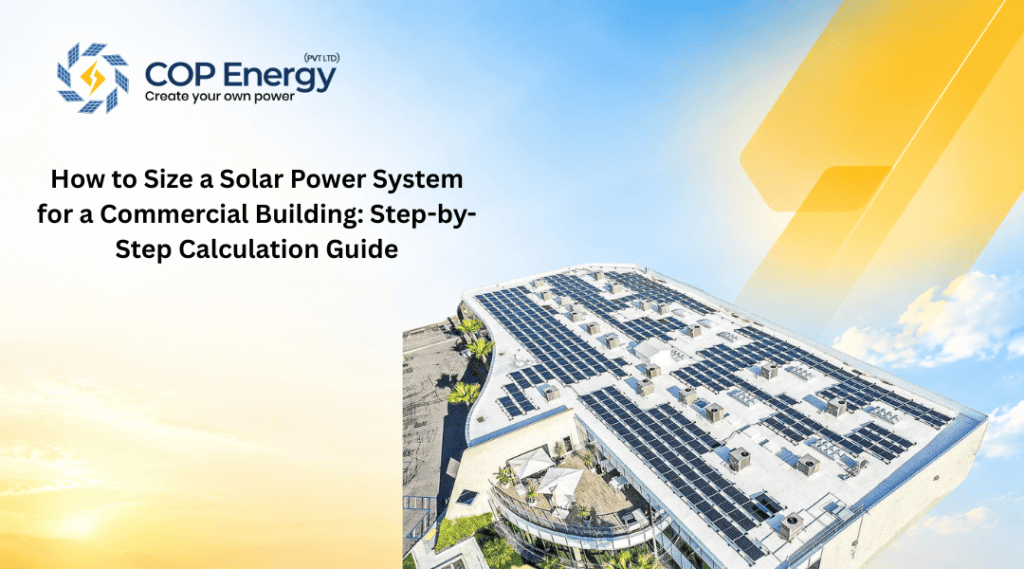
How to Size a Solar Power System for a Commercial Building
A step-by-step guide to electricity analysis, capacity calculations, load profiling, inverter sizing and battery planning.
Introduction
Choosing the right solar system size is one of the most important decisions a commercial building owner or business needs to make before investing in solar energy.
A system that is too small may not deliver the expected electricity savings, while an oversized system can increase the initial investment without providing proportional financial benefits.
Understanding how to size a solar power system for a commercial building therefore requires more than simply counting the available roof space or multiplying the number of solar panels.
A proper commercial solar system calculation should consider:
- Historical electricity consumption
- Monthly and annual energy usage
- Daytime electricity demand
- Solar irradiation
- Available roof area
- System losses
- Solar panel efficiency
- Inverter capacity
- Grid connection
- Battery requirements
- Future electricity demand, including possible EV charging solutions
- Applicable electricity regulations
For businesses, the objective should be to develop a solar system that provides an appropriate balance between energy generation, investment cost, available space and long-term savings.
This guide explains a practical method for calculating the approximate solar capacity required for a commercial building. For official information about India’s solar policies and programmes, refer to the Ministry of New and Renewable Energy.
What Does Solar System Sizing Mean?
Solar system sizing means determining the appropriate solar PV capacity, usually expressed in kilowatts (kW) or megawatts (MW), required to meet a specific portion of a building’s electricity demand.
For example, a commercial building may consume 10,000 kWh of electricity per month.
The objective is to determine whether the building requires approximately:
- 20 kW of solar
- 30 kW
- 50 kW
- 75 kW
- 100 kW
or another capacity based on the building’s consumption, location, available area and financial objectives.
The final system size should be determined through a detailed engineering and financial assessment.
Step 1: Calculate Annual Electricity Consumption
Start with the commercial building’s monthly electricity consumption. If the building consumes 10,000 kWh per month, multiply it by 12 months:
10,000 × 12 = 120,000 kWh/year
Therefore:
Annual electricity consumption = 120 MWh/year
This gives the basic energy requirement against which potential solar generation can be compared.
Step 2: Estimate the Initial Solar Capacity
Assuming the system produces approximately 1,400 kWh per kW per year:
120,000 ÷ 1,400 = 85.7 kW
Therefore:
Solar capacity ≈ 85.7 kW
So, approximately 86 kW of solar capacity could theoretically generate an amount of electricity similar to the building’s annual consumption under those assumptions.
However, this does not automatically mean an 86 kW system is the correct commercial system size.
The actual design must consider daytime consumption, export rules, roof availability and financial objectives.
Step 3: Select a Practical Solar-Offset Target
Annual electricity consumption:
120,000 kWh
Target solar contribution:
60%
Required solar generation:
120,000 × 60% = 72,000 kWh/year
Assume the solar system generates approximately:
1,400 kWh per kW/year
Required capacity:
72,000 ÷ 1,400 = 51.4 kW
Therefore, the preliminary solar size would be approximately:
51–52 kW
This approach is often more practical than attempting to offset the building’s entire annual consumption.
Step 4: Understand DC and AC Capacity
Solar PV systems generally have:
DC capacity: Solar module capacity
AC capacity: Inverter output capacity
The two do not always have to be identical.
For example:
Solar modules: 60 kWp DC
Inverter capacity: 50 kW AC
This type of design can be used in appropriate circumstances to improve inverter utilization, but the correct DC/AC ratio depends on the project’s design conditions.
An engineer should evaluate:
- Module characteristics
- Temperature
- Inverter specifications
- Grid requirements
- Clipping
- Annual energy yield
Step 5: Evaluate Your Electricity Load Profile
Electricity consumption throughout the day is critical.
Consider a commercial building that consumes:
8 AM–6 PM: High electricity demand
This can align well with solar generation.
Another facility may operate:
6 PM–6 AM: High electricity demand
In that situation, a rooftop solar system alone may not meet much of the nighttime demand.
The business may need to evaluate:
- Battery energy storage
- Grid electricity
- Open-access renewable electricity
- Hybrid renewable systems
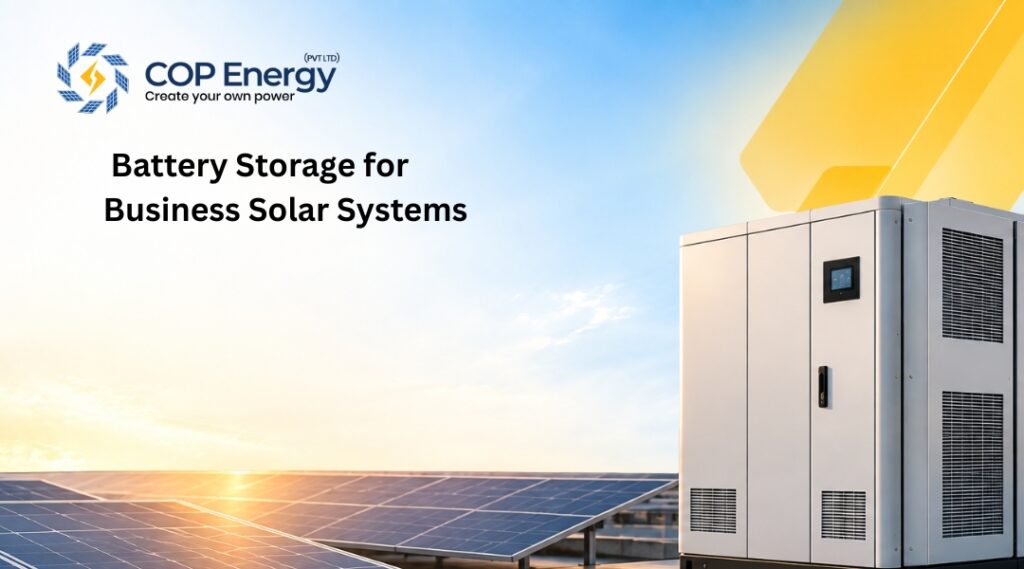
Step 6: Decide Whether Battery Storage Is Required
Not every commercial solar system requires batteries.
Battery storage may be considered when the business needs:
- Backup power
- Peak-demand management
- Evening renewable-energy usage
- Critical-load support
- Greater energy flexibility
The battery should be sized based on energy requirement and power requirement.
For example:
If a business requires 100 kWh of usable energy during a particular period, the battery capacity should not simply be specified as 100 kWh without accounting for:
- Depth of discharge
- Battery efficiency
- Temperature
- Degradation
- Reserve capacity
- Backup duration
A professional battery-storage system design is therefore essential.
Frequently Asked Questions
1. How do I calculate the solar system size for a commercial building?
Start with annual electricity consumption, determine the percentage you want solar to offset, estimate the location-specific solar generation per kW and divide the required annual solar generation by the expected annual generation per kW.
2. How many solar panels does a commercial building need?
It depends on the required system capacity and the wattage of the selected modules. For example, a 100 kW system using 550 W panels would require approximately 182 panels before final engineering adjustments.
3. How much roof area is needed for commercial solar?
The required area depends on module wattage, efficiency, spacing, roof orientation, shading, access pathways and safety requirements. A detailed rooftop layout should be prepared before finalizing capacity.
4. Should I size solar based on my electricity bill?
Electricity bills are an important starting point, but they are not sufficient by themselves. Load profile, daytime consumption, roof area, solar irradiation and electricity regulations should also be considered.
5. Is battery storage necessary for commercial solar?
Not always. Batteries are mainly considered when businesses require backup, evening energy usage, peak-demand management or greater energy flexibility.
6. Can solar completely eliminate my commercial electricity bill?
Not necessarily. Fixed charges, nighttime consumption, demand charges, grid requirements and applicable electricity regulations can mean that a business continues to have some electricity costs.
7. How long does a commercial solar system last?
Solar PV systems are designed for long operating lives, but actual performance depends on module degradation, equipment quality, maintenance and environmental conditions. Individual components may have different warranty and replacement periods.
8. How can I determine the best solar capacity for my business?
The best approach is to combine 12–24 months of electricity data, a load-profile analysis, a professional site survey, solar-generation assessment and a financial feasibility study.
Conclusion
Understanding how to size a solar power system for a commercial building is essential before investing in a rooftop or ground-mounted solar project.
The calculation should begin with actual electricity consumption and progress through daytime load analysis, target solar offset, location-specific solar generation, system losses, roof availability, panel capacity, inverter sizing and financial feasibility.
A simple calculation can provide an initial estimate, but the final commercial solar system size should always be validated through detailed engineering and site assessment.
For businesses, the goal should not simply be to install the largest possible solar plant. The right system is one that balances electricity consumption, solar generation, available space, regulatory requirements, investment cost and long-term savings.
With proper planning, commercial solar can become a strategic energy investment that helps businesses reduce dependence on conventional electricity, improve energy planning and increase renewable-energy adoption. COP Energy solar solutions can support commercial and industrial project planning.
The right solar size is not the biggest system—it is the system designed around the building’s actual energy needs.
Authoritative External Resources
- MNRE – Solar Energy
- MNRE – Renewable Energy Physical Progress
- Ministry of Power – Green Energy Open Access Rules
- IEA – India Energy Outlook and Analysis
Explore More COP Energy Solutions
Plan a Commercial Solar Project
Discuss your building’s electricity use, available space and energy goals with COP Energy.
Contact COP Energy