
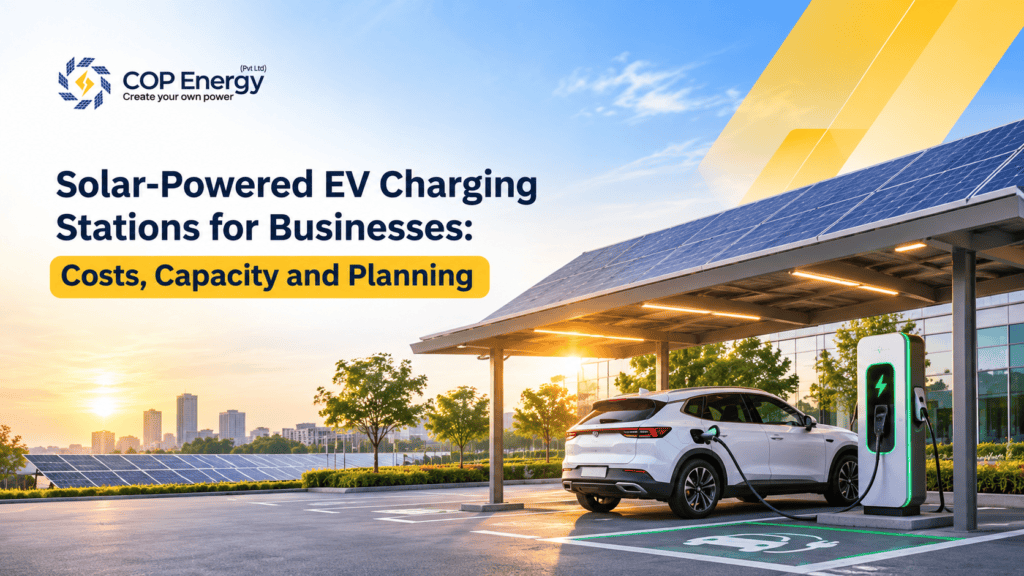
Solar-Powered EV Charging Stations for Businesses: Costs, Capacity and Planning
Electric vehicles are creating new opportunities for businesses to improve their energy infrastructure. Offices, commercial complexes, hotels, warehouses, fleet operators and industrial facilities can consider EV charging stations to support employees, customers and electric vehicle fleets.
Integrating solar power with EV charging can help businesses use renewable electricity generated on-site. However, the success of a solar-powered charging station depends on more than installing solar panels and chargers. Businesses must evaluate charging demand, electrical capacity, available space, operating hours and project economics.
A carefully planned system can support future EV adoption while helping businesses make informed decisions about energy costs and infrastructure investments.
1. Understand How Solar-Powered EV Charging Works
Direct solar-powered charging
During daylight hours, solar panels generate electricity that can supply EV chargers alongside other building loads. If solar generation exceeds immediate demand, the remaining electricity may be exported or used elsewhere, depending on the electrical configuration and applicable regulations.
When solar generation falls below charging demand, electricity may need to come from the grid or another permitted source.
Solar charging with battery storage
A battery energy storage system can store energy for later use, depending on the system’s design and charging strategy. It may help manage fluctuating solar generation, support selected charging periods or reduce some peak-demand costs.
However, batteries add equipment, installation, maintenance and replacement costs. Their financial value should be assessed against actual charging demand and the applicable electricity tariff.
Planning point: Battery storage is not automatically necessary for every solar EV charging project. Assess the charging schedule, grid supply and tariff before including it in the design.
2. Choose the Right EV Charger Capacity
AC chargers for workplace and destination charging
AC chargers are often suitable where vehicles remain parked for extended periods, such as offices, hotels, residential complexes and employee parking facilities.
Charging requirements depend on vehicle compatibility, charger rating, onboard charger limits and parking duration.
DC fast chargers for high-turnover locations
DC fast chargers can deliver higher charging power and are relevant for certain fleet operations, highway locations and commercial sites where faster charging is needed.
They may require substantial electrical capacity and can increase infrastructure costs. Businesses should evaluate utilisation, grid connectivity and the expected number of charging sessions before choosing this option.
Estimate daily charging demand
Consider an illustrative workplace with 20 vehicles requiring an average of 10 kWh each per day.
Daily energy requirement:
20 vehicles × 10 kWh = 200 kWh per day.
This estimate provides a starting point for planning. Actual demand may differ according to vehicle efficiency, battery state of charge, charging losses, travel patterns and user behaviour.
3. Assess Solar Capacity and Electrical Infrastructure
Match solar generation to charging schedules
Solar capacity should be evaluated against expected charging demand and the site’s existing electricity consumption. A business that charges vehicles mainly during daylight may be able to use more on-site solar generation directly than one whose charging demand occurs overnight.
A professional feasibility assessment should account for local solar conditions, roof or carport space, shading, system losses and seasonal variation.
Evaluate the grid connection
Before installing chargers, check the site’s available electrical capacity, distribution equipment, transformer requirements, protection systems and cable routes.
High-power chargers may require electrical upgrades. The project may also require utility approvals, metering arrangements and compliance with applicable technical and safety requirements.
4. Consider Solar Carports for Commercial Parking Areas
Turn parking space into energy infrastructure
Solar carports combine covered parking with solar generation. They can be useful for office campuses, shopping centres, hotels, logistics facilities and fleet parking areas where roof space is limited or additional covered parking is desirable.
The design should consider structural loading, drainage, vehicle clearances, cable routing, accessibility and safe maintenance access.
Plan for future expansion
Businesses should consider whether the electrical distribution system, cable pathways and available space can accommodate additional chargers later.
Planning for expansion during the initial project can help avoid unnecessary redesign and infrastructure work.
5. Understand the Main Cost Components
Equipment and installation costs
The total project cost can include:
- Solar panels, inverters and mounting structures.
- EV chargers and communication systems.
- Electrical cabling, protection and distribution equipment.
- Grid connection or capacity upgrades, where required.
- Battery storage, if included.
- Civil works, foundations or solar carport structures.
- Software, monitoring, installation and commissioning.
- Ongoing maintenance and equipment replacement.
Costs vary substantially by charger type, solar capacity, site conditions, equipment specifications and local electrical requirements. Obtain a site-specific quotation rather than relying on a single generic installation price.
Evaluate the business case
Compare expected charging revenue or operational benefits with installation costs, electricity expenses, maintenance, software charges and equipment depreciation.
For employee charging, the benefits may include workplace convenience and sustainability goals. For public or fleet charging, utilisation and charging revenue may be important factors.
Do not assume that solar integration automatically makes every EV charging project profitable.
6. Review Safety, Compliance and Operations
Before commissioning a charging station, businesses should assess electrical protection, earthing, emergency isolation, cable management, vehicle movement, fire-safety arrangements and equipment suitability for outdoor conditions.
The project should follow applicable Indian electrical standards, relevant charging-infrastructure requirements, local approvals and utility rules. A qualified professional should confirm the requirements for the specific site.
Also decide who will manage charger access, billing, maintenance, fault reporting and customer support.
Businesses can consult official guidance and updates from the Ministry of Power, India, the Ministry of New and Renewable Energy and the Bureau of Energy Efficiency.
7. EV Charging Project Planning Checklist
Before proceeding, confirm that you have:
- Estimated daily charging demand and expected utilisation.
- Selected appropriate AC or DC charger types.
- Assessed available solar installation space.
- Reviewed grid capacity and electrical upgrades.
- Evaluated battery storage only where justified.
- Compared installation, operating and maintenance costs.
- Planned parking layout, safety and accessibility.
- Checked applicable approvals and technical requirements.
- Considered future charger expansion and monitoring.
Conclusion: Build an EV Charging System Around Real Demand
Solar-powered EV charging can help businesses combine renewable electricity with practical transport infrastructure. The most suitable design depends on how many vehicles need charging, when they are parked, how quickly they need to charge and how much electrical capacity the site can support.
Starting with a feasibility assessment helps businesses select an appropriate charger configuration, estimate costs and plan for future growth.
Planning a solar-powered EV charging project? Visit COP Energy to discuss your commercial solar requirements and explore the feasibility of integrating solar generation with EV charging infrastructure.
Planning a Solar-Powered EV Charging Project?
Discuss your commercial solar requirements and EV charging infrastructure plans with COP Energy.
Explore COP Energy