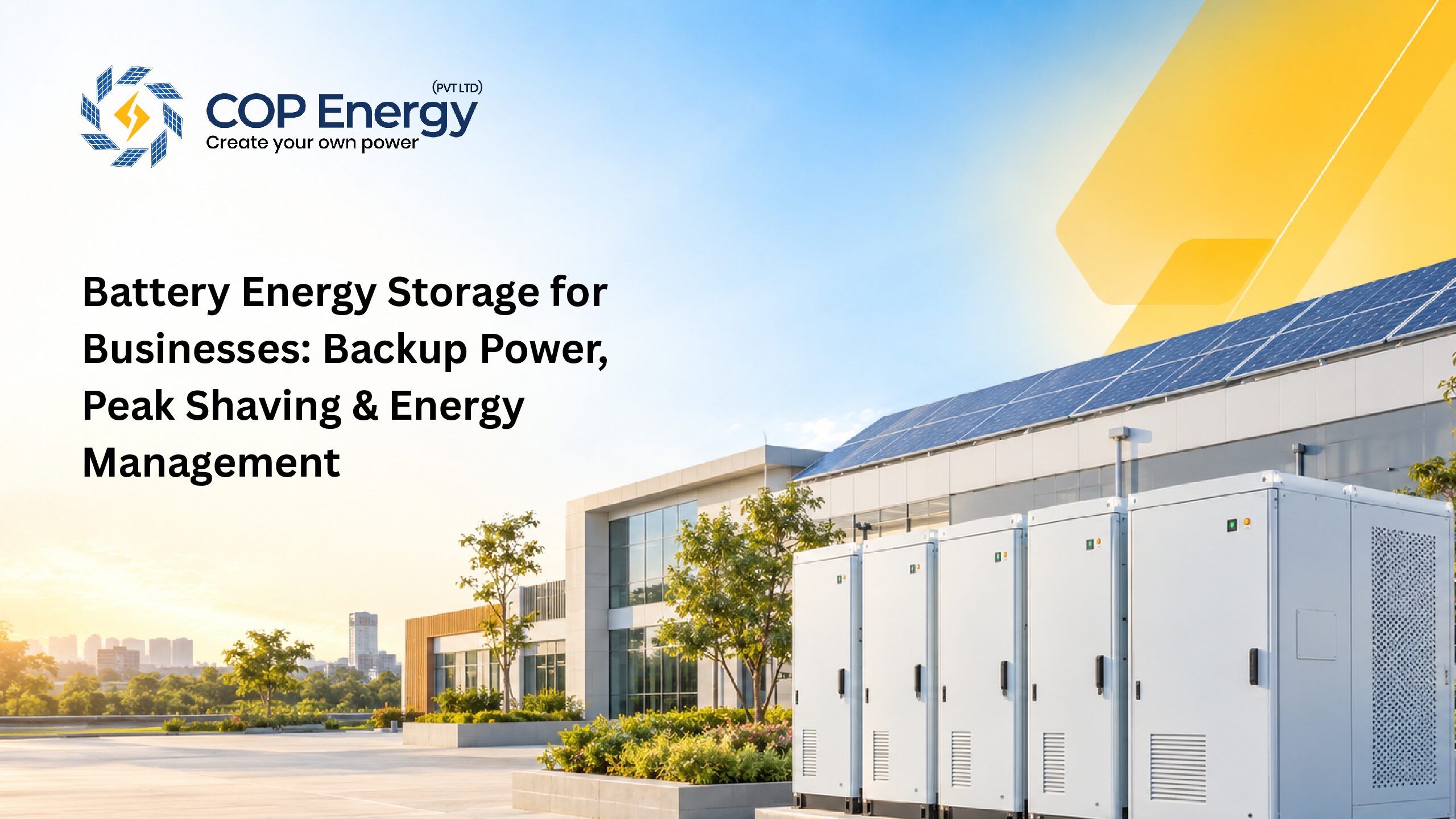
Battery Energy Storage for Businesses: Backup Power, Peak Shaving & Energy Management
Discover how Battery Energy Storage Systems (BESS) can help businesses manage backup power, peak demand, solar energy, time shifting and overall energy resilience.
Businesses increasingly need reliable and flexible energy systems to manage electricity costs, operational continuity and renewable-energy integration.
A battery energy storage system (BESS) allows electricity to be stored and used when required. Depending on the project design, businesses can use battery storage for backup power, peak shaving, energy time shifting, solar integration and broader energy-management applications.
For businesses evaluating battery energy storage for businesses, the most important question is not simply how much battery capacity should be installed. The system should instead be designed around the site’s actual electricity demand, operating schedule, tariff structure, solar generation and critical loads.
Businesses can also explore Battery Energy Storage Solutions from COP Energy when evaluating a project.
What Is a Battery Energy Storage System?
A Battery Energy Storage System, commonly called BESS, stores electrical energy and makes it available when required.
A commercial or industrial BESS typically includes batteries, power-conversion equipment, controls, monitoring systems, protection equipment and other supporting infrastructure.
The exact architecture depends on the application, required power rating, energy capacity, operating environment and control strategy.
1. BESS for Backup Power
One of the easiest business cases to understand is backup power.
A battery can provide electricity to selected loads when the normal electricity supply is interrupted.
However, a BESS is not automatically equivalent to a diesel generator.
The most suitable solution depends on several project-specific factors:
- Required backup duration
- Critical load
- Power rating
- Site operating profile
- Grid reliability
- Generator availability
- Battery capacity
- Recharge strategy
A business can classify its electrical loads according to operational importance.
- Critical: Servers, security, communications and selected production controls.
- Important: Selected lighting, pumps or process systems.
- Non-critical: Comfort or discretionary loads.
The BESS can then be designed around the loads where continuity provides the greatest operational value.
2. BESS for Peak Shaving
Peak shaving is one of the most important commercial applications of battery storage.
A business may experience short periods when electricity demand rises significantly.
Instead of drawing all of the additional power from the grid, the battery can discharge during selected high-demand periods.
Normal demand: 500 kW
Peak demand: 800 kW
A suitably sized battery may discharge during the selected peak period, subject to the site’s tariff structure, operating profile and system design.
3. BESS for Energy Time Shifting
Battery storage can also move electricity consumption from one period to another.
↓
Charge Battery
↓
Store Energy
↓
Higher-Value Period
↓
Discharge Battery
This is called energy time shifting.
Depending on the site’s tariff and operating schedule, time shifting can potentially improve energy economics.
It can also help align energy availability with production requirements.
4. Solar + Battery Storage for Businesses
Solar and battery storage can complement each other.
A solar system generates electricity when sunlight is available, while a battery allows some of that energy to be stored for later use.
+
Solar → Battery → Business Load
A solar-plus-storage system can potentially help a business:
- Use more solar energy internally
- Reduce export during certain periods
- Shift solar energy into later hours
- Improve energy resilience
- Coordinate solar generation with demand
The value of the combination depends on the site’s load profile, solar generation profile, battery size and control strategy.
Businesses planning the solar component can also review COP Energy’s Commercial & Industrial Solar Solutions .
5. Using BESS During Power Outages
A major benefit of battery storage is fast response.
A properly engineered system can be designed to transition designated loads to battery-backed power during a grid interruption, subject to the system architecture and controls.
This can be especially useful for operations where even short interruptions create significant losses.
Potential applications include:
- Data and communication equipment
- Security systems
- Retail systems
- Manufacturing controls
- Healthcare support systems
- Office IT systems
- Critical automation
For longer outages, the BESS may work alongside a generator rather than replacing it.
How Is a BESS Sized for a Business?
BESS sizing should be based on the actual operational requirements of the business rather than simply selecting a larger battery.
Important inputs include:
- Required power output
- Required stored energy
- Backup duration
- Peak electricity demand
- Daily operating schedule
- Electricity tariff
- Solar generation profile
- Critical loads
- Expected cycling frequency
- Site conditions
How Long Does a Commercial BESS Last?
Battery life depends on several factors, including battery chemistry, operating temperature, cycle frequency, depth of discharge, operating strategy and manufacturer specifications.
Buyers should evaluate both the warranty terms and expected usable capacity over time.
Is BESS Safe for Businesses?
Properly engineered battery storage systems can include battery monitoring, electrical protection, thermal management and appropriate fire and emergency-safety measures.
Applicable Indian regulations, project-specific risks and manufacturer requirements should be considered during system design and installation.
India’s BESS Development and Energy-Storage Framework
India’s battery storage ecosystem is developing as renewable-energy integration, grid flexibility and electricity-demand management become increasingly important.
Businesses researching the Indian BESS market can refer to the Central Electricity Authority’s BESS development and deployment information .
For government and energy-policy context, businesses can also review Government of India energy-storage policy and deployment information .
Current BESS capacity and safety-related developments can also be researched through the 2026 BESS update from the Ministry of Power .
Frequently Asked Questions
BESS, or Battery Energy Storage System, stores electricity and makes it available when required. Businesses can use it for backup power, peak shaving, solar energy shifting and broader energy-management applications.
Not always. Batteries are particularly useful for fast-response and short-duration applications, while generators can be better suited to long-duration backup. A hybrid BESS-plus-generator architecture can sometimes provide a stronger solution.
Peak shaving is the use of energy resources such as batteries to reduce electricity drawn from the grid during selected high-demand periods.
Yes. Solar and BESS can be integrated so that excess solar energy can be stored and used later, depending on the system design, load profile and operating strategy.
Battery life depends on chemistry, operating temperature, cycle frequency, depth of discharge, operating strategy and manufacturer specifications. Buyers should evaluate warranty terms and expected usable capacity over time.
Sizing depends on the power that needs to be delivered and the amount of energy that needs to be stored. Load profile, backup duration, peak demand, operating schedule and solar generation are important inputs.
Properly engineered systems include battery monitoring, electrical protection, thermal management and appropriate fire and emergency-safety measures. Applicable Indian regulations, project-specific risks and manufacturer requirements should be considered.
It can in some applications, but not universally. The benefit depends on the value of shifting energy, reducing demand peaks, improving solar utilisation and providing resilience relative to the total lifecycle cost of the storage system.
How COP Energy Can Help
Battery storage works best when it is designed as part of the overall energy system rather than installed as a standalone product.
COP Energy positions its solutions around solar power, battery storage and EV charging, with BESS applications including backup, peak shaving and energy optimisation.
Businesses can explore the COP Energy platform to understand its broader energy solutions.
Related COP Energy Solutions
- Commercial & Industrial Solar Solutions
- Battery Energy Storage System
- EV Charging Solutions
- Residential Solar Solutions
- COP Energy
Conclusion
Battery energy storage for businesses is becoming a strategic energy-management tool rather than simply a backup-power technology.
A well-designed BESS can potentially help businesses manage power interruptions, peak demand, solar energy utilisation, time shifting and energy costs, while also supporting a more resilient electricity strategy.
However, battery capacity alone does not create value. The strongest projects begin with a detailed understanding of the business’s:
- Load profile
- Electricity tariff
- Solar generation
- Outage pattern
- Critical loads
- Operating schedule
The BESS can then be sized and controlled around those real requirements.
For some businesses, a battery may primarily provide backup. For others, the greatest value may come from peak shaving or solar time shifting.
In more advanced installations, the system can operate as part of an integrated solar + BESS + EV charging + energy-management ecosystem .
Plan Your Business Energy Storage System
Discuss your electricity demand, critical loads, solar generation and energy-management requirements with COP Energy.
Contact COP Energy