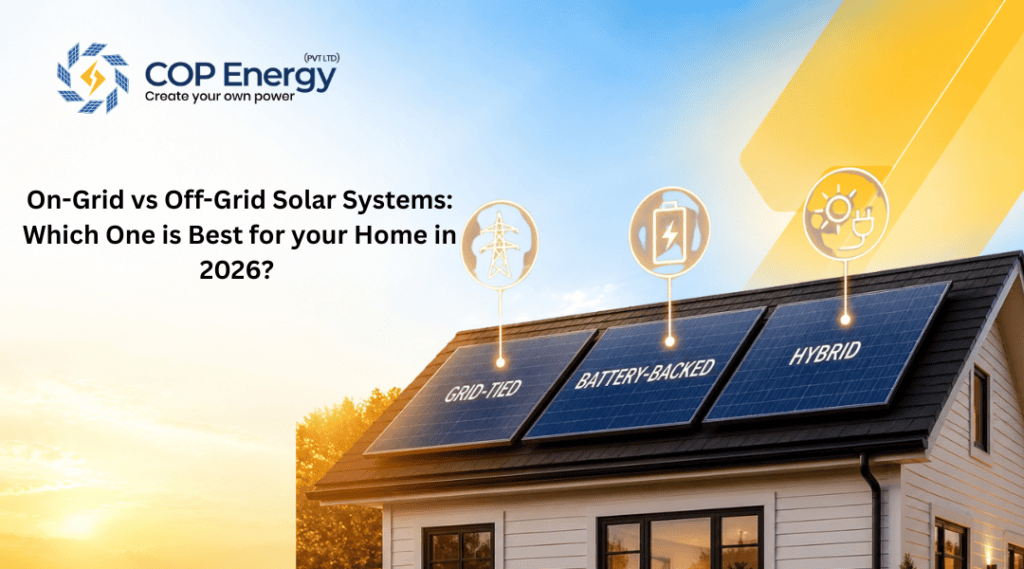
On-Grid vs Off-Grid Solar System: Which Is Better for Your Home in 2026?
Solar energy is rapidly becoming the preferred power solution for homeowners in India. With rising electricity prices, growing awareness about renewable energy, and government support for solar adoption, more families are switching to solar power systems in 2026.
However, many homeowners face one important question before installation: should you choose an on-grid solar system or an off-grid solar system?
Both systems have unique advantages, costs, and applications. The right choice depends on your electricity usage, budget, location, and power backup needs.
What Is an On-Grid Solar System?
An on-grid solar system, also called a grid-tied solar system, is connected directly to the local electricity grid.
The system generates electricity using solar panels, and any excess power is sent back to the electricity grid through net metering.
Solar Panels
Generate electricity from sunlight.
Solar Inverter
Converts solar energy into usable electricity.
Net Meter
Tracks electricity exported and imported from the grid.
How It Works
- Solar panels generate electricity during the daytime
- Your home uses solar energy first
- Excess electricity is exported to the grid
- Electricity is imported from the grid during nighttime
What Is an Off-Grid Solar System?
An off-grid solar system operates independently without relying on the electricity grid.
It stores solar energy in batteries for use during nighttime or power outages.
Battery Bank
Stores excess solar energy for later use.
Charge Controller
Regulates charging and battery performance.
Independent Power
Operates without depending on the electricity grid.
How It Works
- Solar panels generate electricity
- Electricity charges the batteries
- Stored energy powers the home during nighttime or outages
Major Difference Between On-Grid and Off-Grid Solar Systems
| Feature | On-Grid Solar | Off-Grid Solar |
|---|---|---|
| Grid Connection | Connected to electricity grid | Independent of grid |
| Battery Requirement | Not required | Mandatory |
| Backup During Outages | No | Yes |
| Installation Cost | Lower | Higher |
| Maintenance | Low | Moderate to High |
| Net Metering | Available | Not Available |
| Best For | Urban homes | Remote locations |
| Energy Independence | Partial | Complete |
Why More Homeowners Are Choosing Solar in 2026
- Rising electricity bills
- Frequent power outages
- Government subsidies
- Increased environmental awareness
- Better solar panel efficiency
- Affordable financing options
Benefits of On-Grid Solar Systems
Lower Cost
No expensive battery storage is required.
Reduced Bills
Net metering lowers monthly electricity expenses.
High ROI
Most systems recover costs within 4 to 6 years.
Low Maintenance
Battery-free systems require minimal upkeep.
Better Efficiency
On-grid systems generally perform more efficiently.
Urban-Friendly
Ideal for homes with stable electricity supply.
Benefits of Off-Grid Solar Systems
Energy Independence
Generate and store your own electricity.
Backup Power
Continues working during power cuts.
Remote Area Solution
Perfect for locations with poor grid access.
No Electricity Bills
Eliminates dependency on electricity providers.
Sustainable Living
Supports eco-friendly and self-sufficient lifestyles.
Common Problems Homeowners Face
- Insufficient backup during outages
- Higher-than-expected installation costs
- Poor return on investment
- Limited energy storage
- Incorrect system sizing
- Higher maintenance expenses
Which Solar System Is More Cost-Effective in 2026?
On-Grid Solar Costs
1 kW: ₹60,000 – ₹85,000
3 kW: ₹1.8 lakh – ₹2.5 lakh
5 kW: ₹3 lakh – ₹4 lakh
Off-Grid Solar Costs
1 kW: ₹1 lakh – ₹1.5 lakh
3 kW: ₹3 lakh – ₹4.5 lakh
5 kW: ₹5 lakh – ₹7 lakh
Off-grid systems are more expensive mainly because of battery costs.
Which Solar System Saves More Money?
On-Grid Savings
- Lower upfront cost
- Faster ROI
- Excellent for city homes
- Best for reducing electricity bills
Off-Grid Savings
- Complete energy independence
- Useful in outage-prone areas
- Long-term backup benefits
- Higher initial investment
Common Mistakes to Avoid
Ignoring Backup Needs
On-grid systems alone do not provide backup during outages.
Choosing Cheap Batteries
Low-quality batteries reduce efficiency and lifespan.
Wrong System Size
Undersized systems may fail to meet your energy needs.
Ignoring Maintenance
Off-grid systems require regular battery care.
Hiring Inexperienced Installers
Professional installation is critical for performance and safety.
Which Solar System Is Best for Your Home in 2026?
Choose On-Grid Solar If:
- You live in a city
- Your area has reliable electricity
- You want lower electricity bills
- You prefer lower installation cost
- You want faster ROI
Choose Off-Grid Solar If:
- You live in a remote area
- Your location faces frequent power cuts
- You need backup power
- You want energy independence
- You are comfortable with higher investment
Hybrid Solar Systems: The Future of Solar Energy
In 2026, hybrid solar systems are becoming increasingly popular because they combine:
- Grid connectivity
- Battery storage
- Solar power generation
Power Backup
Works during power outages.
Better Energy Management
Balances solar, battery, and grid usage efficiently.
Smart Monitoring
Track production and savings through mobile apps.
Future Trends in Solar Energy for 2026
Smart Solar Technology
AI-powered systems improve energy efficiency.
Advanced Batteries
Lithium-ion batteries offer faster charging and longer backup.
Sustainable Homes
Solar energy is becoming central to eco-friendly living.
Why Choose COP ENERGY?
COP ENERGY provides reliable and customized solar solutions for homes across India.
- Solar consultation
- Site inspection
- Customized system design
- High-quality solar panels
- Professional installation
- Net metering support
- Maintenance services
Frequently Asked Questions
Which is better: on-grid or off-grid solar system?
For most urban homes, on-grid systems are more cost-effective. Off-grid systems are ideal for areas with unreliable electricity.
Can an on-grid solar system work during power cuts?
No. Standard on-grid systems shut down during outages unless battery backup is installed.
Is off-grid solar expensive?
Yes. Off-grid systems cost more because they require batteries and additional components.
What is the lifespan of solar panels?
Most solar panels last 25 years or more with proper maintenance.
What is net metering?
Net metering allows users to export excess solar electricity to the grid and receive electricity credits.
Are solar subsidies available in 2026?
Yes. Government subsidies continue supporting residential solar adoption.
Conclusion
Choosing between an on-grid and off-grid solar system depends on your home’s electricity needs, location, budget, and backup requirements.
For homeowners in cities with stable electricity supply, on-grid solar systems offer the best balance of affordability, efficiency, and long-term savings.
For remote areas or homes facing frequent power cuts, off-grid solar systems provide complete energy independence and reliable backup power.
As solar technology continues evolving in 2026, investing in solar energy is one of the smartest decisions for reducing electricity costs and supporting sustainable living.