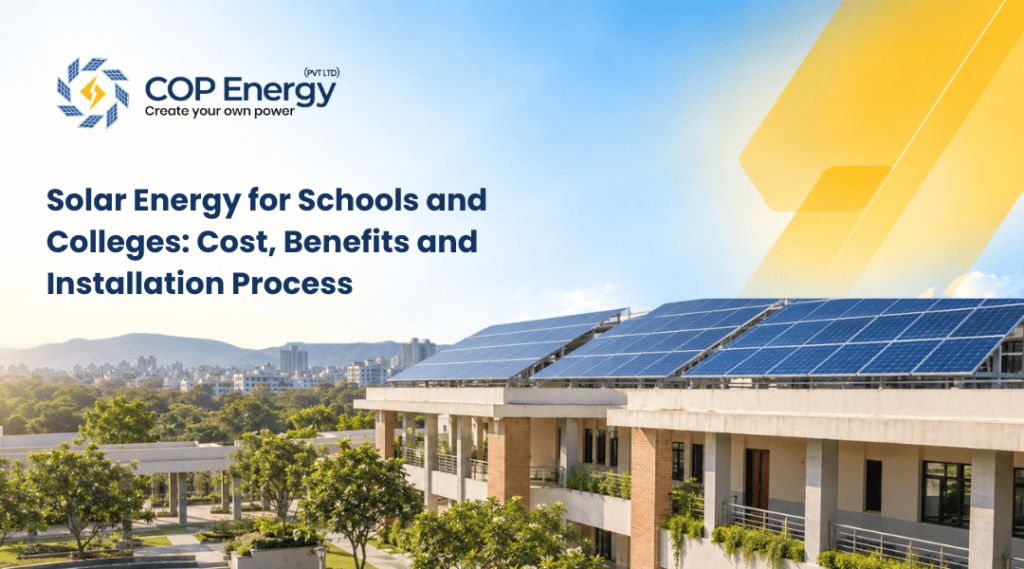
Solar Energy for Schools and Colleges: Cost, Benefits and Installation Process
Schools and colleges typically operate during daylight hours—the same period when a solar photovoltaic system generates most of its electricity. This overlap makes educational institutions potentially suitable candidates for rooftop solar.
Classrooms, laboratories, libraries, administrative offices, computer centres, hostels, water pumps and air-conditioning systems can create substantial electricity demand. A properly designed solar power system can supply part of this daytime requirement, reduce electricity purchased from the grid and make energy expenditure more predictable.
However, installing solar panels on an educational campus requires careful planning. Electricity consumption, roof strength, shading, tariff category, metering arrangements, academic schedules, student safety and long-term maintenance must all be considered.
This guide explains the cost, benefits, financing models and complete installation process for schools and colleges planning to adopt solar energy.
Why Solar Energy Is Suitable for Educational Institutions
The financial value of solar depends heavily on when the generated electricity is consumed.
Many schools and colleges experience their highest electricity use between morning and late afternoon. During these hours, a rooftop solar system can directly serve campus loads such as:
Lights and ceiling fans
Computers and smart classrooms
Science and engineering laboratories
Libraries
Administrative offices
Air-conditioning systems
Water pumps
Canteens and kitchens
Auditoriums
Workshops
Sports facilities
Hostel common areas
Electric-vehicle charging points
When solar generation and campus electricity consumption occur simultaneously, less electricity needs to be imported from the grid.
How a School or College Solar System Works
Solar panels capture sunlight and generate direct-current electricity. A solar inverter converts this DC power into alternating-current electricity compatible with campus equipment and the electrical grid.
The energy generally follows this sequence:
1. Solar panels generate electricity.
2. The inverter converts it into usable AC power.
3. Campus loads consume available solar electricity.
4. The grid supplies any remaining demand.
5. Surplus solar electricity may be exported according to the approved metering arrangement.
6. The electricity meter records imports and eligible exports.
A conventional grid-connected system normally switches off during a grid outage because of mandatory anti-islanding protection. If backup power is required, the institution needs a properly designed hybrid solar, battery-storage or microgrid solution.
Benefits of Solar Energy for Schools and Colleges
1. Lower grid-electricity consumption
The primary financial benefit is the reduction in electricity purchased from the distribution company.
Savings depend on:
Solar-system capacity
Local solar resource
Campus load during solar hours
Applicable electricity tariff
Energy exported to the grid
System losses
Downtime and maintenance
Changes in electricity rates
Savings should be calculated using actual electricity bills and interval load data rather than a generic percentage.
2. Better alignment with daytime consumption
Educational institutions generally operate when the sun is available. This can create strong self-consumption, particularly for facilities with air-conditioning, computer laboratories, workshops or continuous daytime operations.
The higher the proportion of solar electricity used directly on site, the stronger the potential financial value—subject to the applicable tariff and regulations.
3. Protection against rising energy costs
A solar installation involves a significant initial investment but has no fuel cost. It can reduce the institution’s exposure to future grid-tariff increases for the portion of electricity generated and consumed on campus.
Solar does not eliminate every part of an electricity bill. Fixed charges, demand charges, taxes, duties and minimum billing conditions may continue to apply.
4. Productive use of rooftop space
Schools and colleges may have large roofs across:
Classroom blocks
Administrative buildings
Libraries
Hostels
Indoor stadiums
Auditoriums
Canteens
Parking structures
Solar panels can turn suitable, otherwise unused roof areas into electricity-generating assets.
Solar carports can also generate power while providing shade for staff, student and visitor vehicles.
5. Environmental education
A campus solar project can become a practical learning tool.
Students can study:
Solar-energy generation
Weather and irradiance
Carbon accounting
Electrical engineering
Data analysis
Energy conservation
Sustainable development
Economics and project finance
A live monitoring screen can display current generation, daily output and historical performance. This gives students real operational data for classroom projects.
6. Stronger sustainability profile
Solar adoption can support an institution’s environmental commitments and strengthen its sustainability reporting.
It can also demonstrate responsible infrastructure planning to:
Students
Parents
Faculty
Alumni
Governing bodies
Accreditation teams
Research partners
Donors and funding organisations
Environmental claims should be calculated transparently and should not exaggerate the project’s impact.
7. Potential shade and thermal benefits
Elevated panels can provide shade to portions of a roof or parking area. This may reduce direct solar heating of the shaded surface, although the actual impact on indoor temperature depends on roof construction, ventilation, panel clearance and building design.
8. Reduced reliance on diesel generation—with storage
A standard grid-connected solar installation cannot operate independently during an outage. When combined with compatible battery storage and controls, solar can support selected critical loads and potentially reduce diesel-generator use.
Critical loads may include:
Emergency lighting
Security systems
Server rooms
Communication equipment
Essential laboratory equipment
Selected fans and classroom circuits
Water pumping
Medical facilities
Backup requirements must be defined before system design.
How Much Does Solar for a School or College Cost?
There is no single standard price for institutional solar installation. Project cost depends on the site and technical scope.
The total cost generally includes:
Project cost = Equipment + Engineering + Installation + Approvals + Civil work + Monitoring + Long-term maintenance
Major cost factors
System capacity
Larger systems cost more overall, although the cost per kilowatt may fall as project capacity increases due to economies of scale.
Solar panels
Panel cost varies with:
Technology
Wattage
Efficiency
Brand and manufacturer
Product warranty
Performance warranty
Domestic-content requirements, where applicable
Certification and quality
Inverters
The institution may require string inverters, central inverters or—in specialised small and complex installations—microinverters.
The inverter architecture affects initial cost, monitoring, maintenance, system availability and replacement planning.
Mounting structure
Structure cost depends on the roof type, wind-load requirements, roof height, corrosion environment, waterproofing, panel elevation and maintenance access.
Electrical infrastructure
The project may require DC and AC cables, combiner boxes, distribution panels, isolators, circuit breakers, earthing, lightning protection, surge protection, transformer modifications and metering work.
Civil and safety work
Additional work can include roof reinforcement, waterproofing, foundations, cable trays, guardrails, access ladders, fencing, safety signage and inverter rooms.
Battery storage and monitoring
Battery storage can materially increase project cost and should be sized from critical-load, backup-duration or peak-management requirements. Larger campuses may also need weather sensors, energy meters, data loggers, SCADA or a public generation dashboard.
Explore COP Energy’s institutional solar solutions for end-to-end project planning.
Example of Preliminary System Sizing
Assume a college consumes an average of 30,000 units per month.
Its average daily consumption would be approximately:
30,000 ÷ 30 = 1,000 units per day
The solar system should not be sized by monthly consumption alone. The design team must determine:
How much consumption occurs during daylight hours
Whether the campus operates on weekends and holidays
Seasonal demand
Available shadow-free roof area
Permitted grid-connected capacity
Export treatment
Applicable tariff
Transformer and sanctioned-load limitations
If the college has a daytime base load of 400 kW but installs substantially more solar than it can consume, excess generation may be exported or curtailed. The financial value of that excess could differ from the value of electricity consumed directly.
A load-profile study is therefore necessary before finalising capacity.
Understanding Return on Investment
A simple payback estimate can be calculated as:
Simple payback period = Net project cost ÷ Estimated annual net savings
Annual net savings should account for:
Energy-charge reduction
Eligible export credit
Demand-charge impact
Time-of-Day tariff
Operation and maintenance
Insurance
Inverter replacement allowance
Financing cost
System degradation
Expected downtime
Taxes and regulatory charges
A solar proposal should present assumptions clearly instead of promising a guaranteed payback period.
Financing Models for Educational Solar Projects
1. CAPEX model
Under the capital-expenditure model, the institution purchases and owns the solar system, funds the initial investment, receives the electricity savings and manages or contracts long-term maintenance.
2. Solar Power Purchase Agreement
Under a solar PPA or RESCO-style arrangement, a developer may finance, install, own and operate the system while the institution purchases the solar electricity under agreed contractual terms. The institution should review the PPA duration, tariff escalation, roof-access rights, performance obligations, termination terms, insurance and end-of-contract ownership.
3. Loan financing
The institution can own the solar system while financing it through a bank or other lender. The financial model must compare loan repayments with expected electricity savings.
4. Alumni or donor-supported project
Schools and colleges may obtain sustainability funding from:
Alumni associations
Charitable trusts
Corporate social responsibility programmes
Philanthropic organisations
Green-campus initiatives
Clear ownership, maintenance and asset-replacement responsibilities should be established even when the initial project is donated.
5. Government procurement or aggregation
Government educational institutions may procure solar through a tender, government programme, centralised agency or utility-led model. Applicable public-procurement, technical and financial rules must be followed.
Are Schools and Colleges Eligible for Residential Solar Subsidies?
Educational institutions should not assume that they qualify for residential rooftop-solar subsidies.
MNRE’s grid-connected rooftop programme states that Central Financial Assistance under the relevant component is provided to residential electricity consumers. A normal school or college connection does not become eligible merely because solar panels are installed on its roof. MNRE Grid-Connected Rooftop Solar Programme
Government buildings may be covered by separate programmes, procurement models or implementation guidelines. Private and government educational institutions should verify current eligibility with:
MNRE
The relevant DISCOM
The state nodal agency
The institution’s governing authority
The programme’s official guidelines
No subsidy should be included in a financial proposal until eligibility is confirmed in writing.
Installation Process for Schools and Colleges
Step 1: Collect electricity data
Begin with at least 12 months of electricity bills. Record monthly consumption, tariff category, supply voltage, sanctioned load, contracted and recorded demand, power factor and Time-of-Day usage.
Step 2: Conduct an energy audit
Identify academic-day, weekend, holiday and hostel loads. Review laboratories, HVAC, pumps, workshops, future buildings and EV-charging plans. Consider energy-efficiency improvements before finalising solar capacity.
Step 3: Complete a site survey
Inspect roof dimensions and condition, shading, orientation, water tanks, HVAC equipment, cable routes, inverter locations, electrical panels, transformers, earthing, fire access and meter locations.
Step 4: Perform a structural assessment
A qualified structural professional should confirm that the roof can safely support the panels, mounting system, wind loads, walkways and maintenance personnel. Waterproofing and drainage must also be protected.
Step 5: Conduct a shading analysis
Assess nearby buildings, trees, parapets, tanks, communication equipment and future construction across seasonal sun paths.
Step 6: Design the solar system
The engineering design should define system capacity, module layout, inverters, strings, mounting structures, cables, protection, earthing, lightning protection, monitoring, maintenance access and expected generation.
Step 7: Obtain institutional and grid approvals
Management, governing-body, finance, procurement, building and safety approvals may be required. The developer should then coordinate feasibility, capacity, metering, inspection and synchronisation requirements with the relevant DISCOM.
Step 8: Procure compliant equipment
Evaluate certification, warranties, service support, compatible components, spare parts and long-term operating value—not only the lowest quotation.
Step 9: Plan safe campus installation
Schedule work around examinations and campus activity. Restrict access to lifting zones, electrical equipment and rooftops, and coordinate planned power shutdowns.
Step 10: Install, test and commission
Complete mounting, cabling, protection, earthing, monitoring and grid connection. Commissioning should include polarity, insulation, earthing, protection, inverter, anti-islanding, meter and monitoring checks. Provide the institution with drawings, test reports, manuals, warranties and credentials.
To see related work, visit COP Energy’s solar project portfolio.
Operation and Maintenance
Solar systems require ongoing care to maintain safety and performance.
Routine maintenance can include:
Module cleaning
Visual inspection
Structure and fastener checks
Cable inspection
Connector and termination checks
Inverter cleaning and diagnostics
Earthing and protection-device testing
Monitoring and generation review
Drainage, vegetation and access inspection
Maintenance frequency should reflect local dust, rainfall, bird activity, water quality and the manufacturer’s instructions.
Frequently Asked Questions
1. Is solar energy suitable for schools and colleges?
Yes, particularly when the institution has substantial daytime electricity consumption and suitable shadow-free roof space. A site-specific feasibility study is still necessary.
2. How much solar capacity does a school need?
Capacity depends on daytime consumption, roof area, tariff, sanctioned load, export rules, academic calendar and budget. At least 12 months of electricity bills should be analysed.
3. How much does a school solar system cost?
Cost depends on capacity, equipment, roof type, structural work, electrical infrastructure, monitoring and battery requirements. A site survey is required for an accurate quotation.
4. Can solar panels run an entire school?
They may supply a substantial part of annual electricity consumption, but complete dependence on solar requires careful load management, storage and backup planning. Grid-connected systems normally continue using grid electricity when solar generation is insufficient.
5. Will the school have electricity during a power cut?
Not from a conventional grid-tied solar system alone. Anti-islanding protection switches the inverter off during grid failure. Batteries and compatible backup controls are required for outage support.
6. Are schools eligible for PM Surya Ghar subsidy?
PM Surya Ghar’s consumer CFA component is designed for eligible residential consumers. Schools and colleges should not assume eligibility. Government institutions may have access to separate programmes or procurement models.
7. How much roof space is required?
Space depends on panel wattage, layout, tilt, shading, access pathways and roof obstructions. A physical survey and layout drawing are required to determine usable capacity.
8. Can solar be installed over a school playground or parking area?
Solar carports or elevated structures may be possible, subject to structural design, safety, access, drainage, vehicle clearance and approvals.
9. How long does installation take?
The timeline depends on capacity, roof condition, approvals, procurement, grid connectivity and academic scheduling. The EPC contractor should provide a project-specific programme.
10. How frequently should panels be cleaned?
Cleaning frequency depends on dust, rainfall, bird activity, roof access and observed performance loss. Cleaning should follow a documented safety procedure and manufacturer recommendations.
11. Can the system be expanded later?
Yes, if expansion is included in the original electrical and structural planning. Available roof area, inverter capacity, transformer rating and grid approval must be checked.
12. Should a college install battery storage?
A battery may be useful for critical-load backup, peak-demand management or solar-energy shifting. It should be selected only after analysing the load profile, outage requirements and lifetime cost.
13. What warranties should an institution check?
Review module product and performance warranties, inverter warranty, mounting-structure warranty, installation workmanship, monitoring support and service-response obligations.
14. Can students use solar-generation data for academic projects?
Yes. A monitored solar system can provide useful data for engineering, environmental science, economics and sustainability projects. Access controls should protect the operational system.
Conclusion
Solar energy can help schools and colleges reduce grid-electricity consumption, manage long-term energy expenditure and create a visible commitment to sustainability.
COP Energy provides end-to-end solar EPC solutions for educational institutions, from energy audits and system design to installation, commissioning and ongoing performance support. A professional site assessment can help your school or college determine the right solar capacity, financial model and implementation plan. Explore our solar insights or contact COP Energy to discuss your campus.
Regulatory note: Subsidies, tariffs, metering rules and grid-connectivity requirements may change. Eligibility and project economics should be verified using current MNRE, TGERC and DISCOM documents before investment approval.
Official Resources
- MNRE Grid-Connected Rooftop Solar Programme
- TGERC Current-Year Tariff Orders
- BIS Compulsory Registration Scheme
Plan Solar for Your Educational Campus
Let COP Energy assess your electricity use, roof, academic calendar, approvals and financing options.