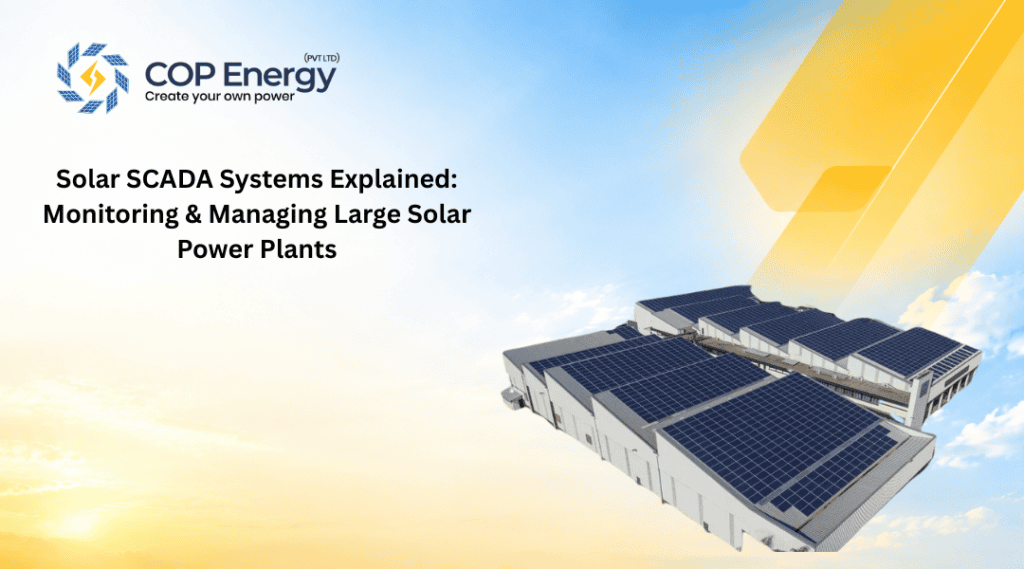
Solar SCADA Systems Explained
Monitoring and managing large solar power plants through centralized data acquisition, alarms, analytics and supervisory control.
Introduction
As solar power plants become larger and more complex, simply installing solar panels and inverters is no longer enough. Operators need reliable systems to monitor electricity generation, identify equipment problems, analyze performance and respond quickly to abnormal operating conditions.
This is where solar SCADA systems become important.
SCADA stands for Supervisory Control and Data Acquisition. In a large solar power plant, SCADA acts as a centralized platform that collects operational information from equipment across the plant and presents that information to operators.
A solar SCADA system can collect data from:
- Solar inverters
- Weather stations
- Energy meters
- Transformers
- Switchgear
- String monitoring devices
- Tracker systems
- Plant controllers
- Battery storage systems
- Protection equipment
The collected information can then be analyzed through dashboards, alarms, reports and performance-monitoring tools.
For utility-scale and commercial and industrial solar solutions, SCADA can become an important part of solar plant monitoring, automation, troubleshooting and operations & maintenance (O&M).
What Is a Solar SCADA System?
A solar SCADA system is a centralized monitoring and control system used to supervise the operation of a solar photovoltaic power plant.
It combines:
Field Devices → Communication Network → Data Acquisition → SCADA Server → Monitoring Dashboard → Operator
The system continuously receives information from different components and converts it into useful operational data.
For example, operators may be able to see:
- Current power generation
- Voltage
- Current
- Frequency
- Energy generated
- Inverter status
- Transformer temperature
- Weather conditions
- Irradiance
- Plant availability
- Equipment alarms
Depending on the plant’s design and applicable controls, SCADA may also provide supervisory control functions.
Why SCADA Is Important for Large Solar Power Plants
A small solar installation may be relatively easy to inspect manually.
A large solar plant can contain:
- Thousands of solar modules
- Hundreds of strings
- Multiple inverters
- Several transformers
- Extensive cabling
- Weather stations
- Trackers
- Switchgear
- Grid-interface equipment
Manually checking every component is inefficient and can delay fault detection.
SCADA provides a centralized view of plant operations.
Instead of physically inspecting every part of the site, operators can identify potential issues from a control room or remote monitoring center.
How Solar SCADA Works
A typical solar SCADA architecture has several layers.
Layer 1: Field Equipment
Equipment generates operational data.
Examples include:
- Inverters
- Meters
- Sensors
- Weather stations
- Transformers
- Trackers
Layer 2: Communication
Data is transferred through communication networks.
Common technologies may include:
- Ethernet
- Fiber optic communication
- Industrial Ethernet
- Serial communication
- Modbus
- IEC-based communication protocols
Layer 3: Data Acquisition
Data acquisition devices collect information from field equipment and transfer it to the SCADA system.
Layer 4: SCADA Server
The server processes and stores operational information.
Layer 5: Human-Machine Interface
Operators access the information through dashboards and graphical interfaces.
This allows them to monitor the entire plant from a centralized location.
Main Components of a Solar SCADA System
1. Solar Inverter Monitoring
Inverters are among the most important data sources in a solar plant.
SCADA can monitor parameters such as:
- AC power
- DC power
- Voltage
- Current
- Frequency
- Inverter temperature
- Operating status
- Fault codes
- Energy production
If an inverter stops operating, an alarm can notify the operator.
This can help reduce downtime.
2. Weather Station
Solar generation depends heavily on environmental conditions. The NREL solar resource data and tools provide an authoritative reference for solar-resource assessment.
A solar plant weather station may measure:
- Solar irradiance
- Ambient temperature
- Module temperature
- Wind speed
- Wind direction
- Humidity
- Rainfall
Irradiance data is particularly useful for evaluating whether the plant is producing the expected amount of electricity.
For example:
High irradiance + low generation
could indicate a possible equipment or operational problem.
3. Energy Meters
Meters provide important information about electrical energy flows.
SCADA may monitor:
- Generation
- Export
- Import
- Voltage
- Current
- Frequency
- Reactive power
- Power factor
Accurate metering is important for plant performance analysis and grid interaction.
4. Transformer Monitoring
Large solar plants typically use transformers to increase voltage before electricity is transmitted to the grid.
SCADA can monitor parameters such as:
- Transformer temperature
- Oil temperature, where applicable
- Voltage
- Current
- Protection status
- Alarm conditions
Monitoring can help operators identify abnormal operating conditions.
What Data Does Solar SCADA Monitor?
A comprehensive solar power plant monitoring system can collect large amounts of operational information.
| Parameter | Why It Matters |
|---|---|
| Active Power | Measures current generation |
| Energy | Tracks cumulative production |
| Voltage | Indicates electrical operating condition |
| Current | Helps identify electrical abnormalities |
| Frequency | Supports grid monitoring |
| Irradiance | Shows available solar resource |
| Module Temperature | Helps explain generation changes |
| Ambient Temperature | Supports performance analysis |
| Inverter Status | Shows equipment availability |
| Transformer Data | Monitors electrical infrastructure |
| Tracker Position | Confirms tracking performance |
| Alarm Status | Helps identify faults |
| Power Factor | Supports electrical performance monitoring |
Real-Time Monitoring With Solar SCADA
One of the biggest advantages of SCADA is real-time visibility.
Operators can monitor:
Plant → Inverters → Transformers → Grid → Weather
from a centralized interface.
A dashboard may show:
- Current plant output
- Today’s generation
- Monthly generation
- Total generation
- Plant availability
- Irradiance
- Active alarms
- Inverter status
This helps operators understand plant conditions without waiting for manual inspections.
Solar SCADA Alarm Management
Alarm management is a critical feature.
When an abnormal condition occurs, SCADA can generate an alert.
Examples include:
- Inverter fault
- Communication failure
- Grid outage
- Over-temperature
- Low generation
- Breaker trip
- Transformer alarm
- Tracker fault
- Sensor failure
An effective alarm system should prioritize events according to severity.
Critical Alarm
Requires immediate attention.
Warning
Indicates an abnormal condition that should be investigated.
Information
Provides operational information without requiring immediate action.
Proper alarm configuration helps prevent operators from being overwhelmed by unnecessary alerts.
Fault Detection in Solar Power Plants
Solar SCADA can support early identification of equipment problems.
For example, suppose several inverters are operating normally but one inverter suddenly shows significantly lower generation.
Operators can investigate:
- Inverter status
- DC input
- AC output
- String-level information
- Irradiance
- Temperature
- Alarm history
This can reduce the time required to identify potential faults.
Solar SCADA and Performance Monitoring
SCADA data can be used to evaluate plant performance.
One important metric is Performance Ratio (PR).
PR compares actual energy production against the energy that could theoretically be produced under the available solar resource and system conditions.
A simplified conceptual relationship is:
Performance Ratio = Actual Plant Output ÷ Expected Output
Actual engineering calculations use standardized methodologies and detailed input data.
Tracking PR over time can help operators identify:
- Soiling
- Equipment degradation
- Availability issues
- Shading
- Electrical losses
- Tracker problems
- Inverter underperformance
SCADA and Solar Plant Availability
Plant availability measures how much of the plant is operational and capable of producing electricity.
For example, if multiple inverters are unavailable, total plant output may fall even when solar irradiance is strong.
SCADA can help identify:
- Which equipment is offline
- When it went offline
- How long it remained offline
- Whether the issue has been resolved
This information can support O&M teams in prioritizing corrective actions.
SCADA for Predictive Maintenance
Traditional maintenance often follows fixed schedules.
Modern solar operations increasingly use data to identify potential problems before major failures occur.
SCADA data can support predictive maintenance by identifying unusual patterns.
For example:
Increasing inverter temperature + declining efficiency + repeated alarms
may indicate a developing equipment problem.
Operators can investigate before the problem becomes more serious.
SCADA itself does not automatically guarantee predictive maintenance; advanced analytics, appropriate sensors and maintenance processes may also be required.
Solar SCADA and Remote Monitoring
Large solar plants may be located far from cities or centralized operations teams.
Remote monitoring allows authorized operators to review plant status without being physically present at the site.
This can support:
- Remote troubleshooting
- Alarm management
- Performance monitoring
- Reporting
- O&M coordination
However, remote access should be secured through appropriate cybersecurity controls.
SCADA for Solar O&M
Operations and maintenance teams can use SCADA data for daily activities.
Daily Monitoring
Review:
- Generation
- Alarms
- Inverter availability
- Irradiance
- Plant status
Weekly Analysis
Compare:
- Energy production
- PR
- Equipment performance
- Fault frequency
Monthly Reporting
Prepare:
- Generation reports
- Availability reports
- Downtime reports
- Alarm summaries
- Performance analysis
This can make O&M management more data-driven.
Solar SCADA Reports
A good SCADA platform should provide useful reporting capabilities.
Reports may include:
Daily Generation Report
Shows energy produced during each day.
Monthly Generation Report
Compares actual generation with expected performance.
Inverter Report
Shows the operating status and energy contribution of individual inverters.
SCADA vs Solar Monitoring System
These terms are sometimes used interchangeably, but they can have different meanings.
A basic solar monitoring system may simply display:
- Energy generation
- Inverter status
- Basic alerts
A full SCADA system generally provides broader capabilities, potentially including:
- Multi-device data acquisition
- Centralized monitoring
- Historical data storage
- Alarm management
- Control functions
- Plant-level integration
- Reporting
- Communication with other control systems
The exact functionality varies by project and system architecture.
SCADA Data Storage and Historical Analysis
SCADA systems can store historical information for later analysis.
Historical data helps answer questions such as:
- When did generation decline?
- Which inverter has the most faults?
- How frequently does a particular alarm occur?
- How has plant performance changed?
- Was an equipment problem isolated or recurring?
Long-term data can become valuable for improving maintenance and investment decisions.
Solar SCADA for Large Solar Power Plants
The importance of SCADA increases as plant size and equipment count increase. For official Indian solar-sector context, review the MNRE solar energy overview and renewable-energy physical progress.
A large utility-scale project may need to coordinate:
Thousands of Modules → Strings → Inverters → Transformers → Switchgear → Substation → Grid
SCADA provides a centralized operational layer across this infrastructure.
This makes it particularly valuable for:
- Utility-scale solar farms
- Large commercial solar projects
- Hybrid renewable plants
- Solar + battery projects
- Multi-site renewable portfolios
SCADA and Battery Energy Storage
As solar projects increasingly incorporate battery storage, SCADA architectures may need to integrate BESS information.
Monitoring may include:
- Battery state of charge
- Charging/discharging power
- Battery temperature
- System availability
- Alarm status
- Energy throughput
This allows operators to understand solar and storage performance together.
For businesses considering solar-plus-storage solutions, explore COP Energy’s Battery Energy Storage System service.
Frequently Asked Questions
1. What is a solar SCADA system?
A solar SCADA system is a centralized supervisory monitoring and control platform that collects data from solar plant equipment and presents it to operators for monitoring, analysis and, where designed, supervisory control.
2. Why is SCADA important for solar power plants?
SCADA provides centralized visibility into plant performance, equipment status, alarms and energy generation. This can help operators identify problems faster and improve O&M activities.
3. What equipment can SCADA monitor?
Depending on the project, SCADA can monitor inverters, meters, weather stations, transformers, switchgear, trackers, plant controllers and battery storage systems.
4. Can SCADA monitor solar plants remotely?
Yes. A properly designed and secured SCADA architecture can allow authorized personnel to monitor plant performance remotely.
5. Does SCADA improve solar plant efficiency?
SCADA does not generate additional electricity by itself. However, its monitoring and analytical capabilities can help operators identify underperformance, equipment faults and operational issues that may otherwise reduce plant output.
6. What data does a solar SCADA system collect?
Typical data includes power, energy, voltage, current, frequency, irradiance, temperature, equipment status, alarms and other plant-specific measurements.
7. Is SCADA required for every solar installation?
The complexity and requirements vary by project. Large utility-scale plants generally have more extensive monitoring and control requirements than small solar installations.
8. Can SCADA integrate with battery storage?
Yes. SCADA architectures can be designed to integrate BESS information such as state of charge, power, temperature, status and alarms.
9. How does SCADA help solar O&M?
SCADA provides historical and real-time data that can help O&M teams identify faults, analyze downtime, prioritize maintenance and monitor equipment performance.
10. Is cybersecurity important for solar SCADA?
Yes. Solar SCADA systems are connected to operational technology and communications infrastructure, so access control, network segmentation, secure remote access, monitoring and appropriate cybersecurity practices are important.
Conclusion
Solar SCADA systems have become an important technology for monitoring and managing large solar power plants. As solar projects grow in capacity and complexity, operators need more than basic generation monitoring. They need visibility into inverters, weather conditions, transformers, meters, switchgear, trackers, alarms and plant-level performance.A well-designed SCADA system brings this information together through a centralized platform, allowing operators to monitor plant conditions, analyze historical performance and respond to operational issues more effectively. SCADA can also support solar O&M, performance analysis, fault detection, reporting and remote monitoring. When integrated with appropriate cybersecurity, communication infrastructure and analytics, it can become a key component of modern renewable-energy operations. Learn more about COP Energy.
Plan Smarter Solar Infrastructure
Explore COP Energy’s solutions for large commercial, industrial and solar-plus-storage projects.