Solar Plus Battery Backup for Indian Businesses: Planning for Power Cuts Without Overspending
Power interruptions can affect manufacturing, refrigeration, IT equipment, security systems and other essential business operations. For facilities that require reliable electricity, combining solar power with battery energy storage can provide an additional way to manage energy use and support selected loads during outages.
However, solar panels alone do not guarantee backup power. A grid-connected solar inverter may shut down during a power failure unless the system is specifically designed to operate safely in backup or islanded mode. Businesses should therefore assess their backup requirements before investing in a solar-plus-battery solution.
COP Energy can be approached to discuss commercial solar and battery storage requirements based on a facility’s energy consumption and operational priorities.
1. Understand How Solar and Battery Backup Work Together
The role of solar panels
Solar panels generate electricity during daylight hours. A business can use this energy to power its operations and, where the system and applicable arrangements permit, charge a battery.
Actual generation depends on installed capacity, sunlight, shading, equipment performance and weather conditions.
The role of battery energy storage
A battery energy storage system (BESS) stores electrical energy for later use. Depending on its configuration, the stored energy can support essential equipment during an outage or help shift electricity consumption away from expensive periods.
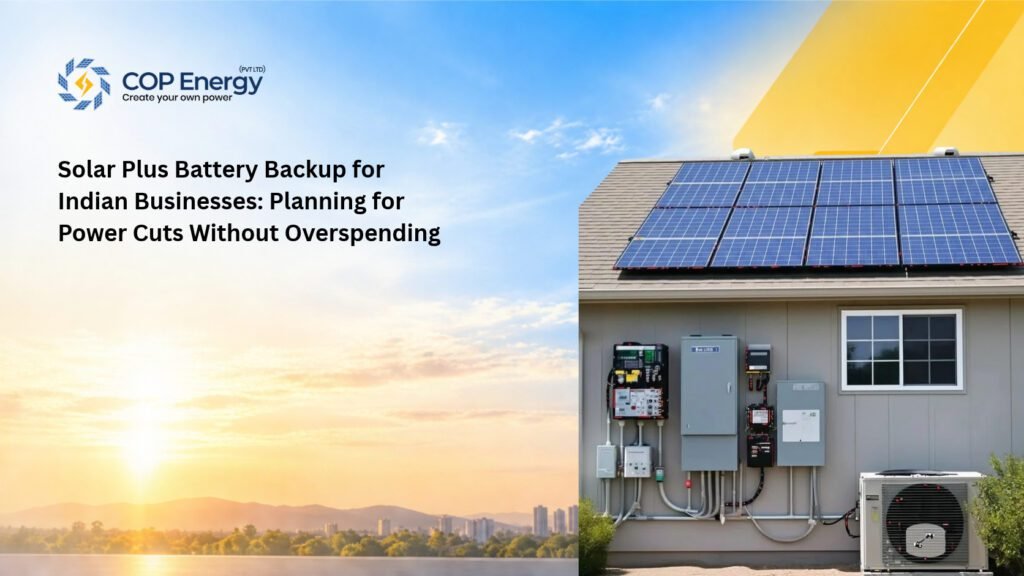
A complete backup solution may require a compatible inverter, battery management system, transfer equipment, isolation and protection devices, and suitable controls. The Ministry of New and Renewable Energy (MNRE) provides official information on energy storage in India.
Why grid-connected solar may not provide backup
Standard grid-following solar systems generally disconnect when the grid fails to protect utility workers and comply with safety requirements. Backup operation requires appropriately designed equipment capable of supplying isolated loads safely.
Businesses should confirm the proposed system’s actual backup functionality with the system designer.
2. Identify Which Equipment Needs Backup
Separate critical loads from non-essential loads
Start by identifying the equipment that must continue operating during a power cut. Examples include:
- Essential production controls and automation.
- Servers, network equipment and communication systems.
- Security, access-control and emergency systems.
- Selected refrigeration or temperature-control equipment.
- Critical pumps and process equipment.
Not every machine needs battery backup. Large motors, compressors and equipment with high starting currents can significantly increase system requirements.
Calculate the required backup duration
Estimate how long critical equipment must operate during an outage. A business needing short-duration support for controls will have different requirements from a facility that must maintain selected processes for several hours.
3. Size the Battery to Match Actual Demand
Estimate energy consumption
Battery sizing should be based on the energy required by backup loads, not the factory’s total connected load alone.
For example, suppose the selected backup loads consume 10 kW continuously for four hours.
Required usable energy:
10 kW × 4 hours = 40 kWh
This is the usable energy required before accounting for system losses, reserve capacity, battery operating limits and other design factors.
Consider battery power as well as capacity
Battery capacity, measured in kWh, indicates how much energy can be stored. Power, measured in kW, indicates how much electricity the system can deliver at a given moment.
A battery with sufficient energy capacity may still be unsuitable if its inverter cannot handle simultaneous loads or motor-starting requirements.
4. Evaluate the Financial Case Before Investing
Compare battery costs with the value of backup
Assess the potential cost of downtime, product spoilage, interrupted production and equipment shutdowns. Compare these risks with the battery system’s installed cost, expected life, maintenance requirements and replacement considerations.
Consider peak-demand management
Depending on the applicable tariff, battery storage may help reduce certain peak-demand costs by supplying energy during selected periods. The benefit depends on the billing structure, operating schedule, charging strategy and available battery capacity.
Do not assume that every battery installation will automatically reduce electricity bills. To understand how this strategy works in more detail, read our guide on solar peak shaving for businesses.
5. Avoid Common Battery Investment Mistakes
- Buying storage capacity without analysing actual backup loads.
- Assuming rooftop solar will work during every grid outage.
- Ignoring inverter power limits and motor-starting currents.
- Overlooking battery temperature, ventilation and fire-safety requirements.
- Failing to check warranty terms, usable capacity and degradation.
- Ignoring future expansion, maintenance and replacement costs.
- Assuming a battery can provide uninterrupted power without proper system design.
For guidance on efficient energy use, businesses can also refer to the Bureau of Energy Efficiency (BEE).
Conclusion: Design Backup Around Business Priorities
Solar-plus-battery systems can help businesses improve energy resilience when designed around actual loads, outage duration and operational requirements. The best solution is not necessarily the largest battery; it is a system that meets essential backup needs while maintaining a sensible financial case.
Looking to plan battery backup for your business? Visit COP Energy to discuss your energy requirements and explore suitable commercial solar solutions.
Plan Battery Backup for Your Business
Discuss your critical loads, outage duration and energy requirements to explore a solar and battery storage solution that fits your business.
Contact COP Energy