How Long Does a Solar Battery Last? Lifespan, Warranty and Replacement Guide
Last updated: July 2026 | Reviewed by the COP Energy technical team
There is no single lifespan that applies to every battery. The actual answer depends on several factors: battery chemistry, number of charge-discharge cycles, depth of discharge, ambient temperature, charging speed, discharge rate, battery-management settings, system design, maintenance, manufacturer quality and warranty conditions.
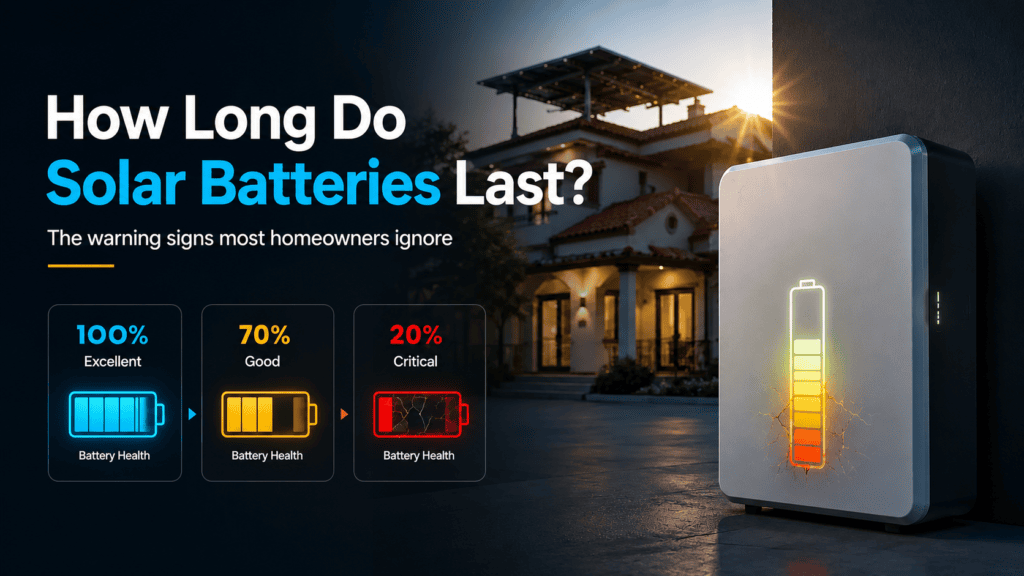
Solar batteries do not normally stop working suddenly at a fixed age — their storage capacity gradually decreases over time. For example, a battery that originally stored 10kWh may still operate after several years but only store 7kWh or 8kWh. NREL field modelling of selected behind-the-meter lithium-ion systems estimated capacity degradation of approximately 20% to 35% over ten years under the tested conditions, though actual results vary substantially by battery model, climate and usage.
Solar Battery Lifespan at a Glance
| Battery Type | Indicative Lifespan | Typical Usage |
|---|---|---|
| Flooded lead-acid | 3–5 years | Budget backup and off-grid systems |
| Tubular lead-acid | 4–7 years | Home inverter and solar backup |
| AGM lead-acid | 3–6 years | Maintenance-reduced backup |
| Gel lead-acid | 4–8 years | Off-grid and specialised systems |
| Lithium-ion NMC | 7–12 years | Residential and commercial storage |
| Lithium iron phosphate | 8–15 years | Daily solar cycling and hybrid systems |
| Commercial BESS | 8–15 years or more | Peak shaving, backup and energy management |
These are general planning ranges rather than guaranteed service periods. The useful life of an individual product should be evaluated using the manufacturer warranty, rated cycle count, permitted depth of discharge, energy-throughput warranty, retained-capacity guarantee and operating-temperature limits.
What Does Solar Battery Lifespan Mean?
Calendar Life
The number of years a battery is expected to remain useful, regardless of how many times it is charged and discharged. A battery can lose capacity even when used infrequently, because chemical ageing continues over time.
Cycle Life
How many equivalent full charge-discharge cycles a battery can complete before its capacity falls to a specified level. A battery rated for 6,000 cycles does not automatically last exactly 6,000 days — actual cycle accumulation depends on how the system is operated.
Throughput Life
Some warranties specify the total electricity (kWh or MWh) that can pass through a battery during the warranty period. Whichever limit is reached first — years, cycles or throughput — may determine the warranty coverage.
How Long Does a Lithium-Ion Solar Battery Last?
A lithium-ion solar battery commonly lasts approximately 8 to 15 years, depending on its chemistry and operating conditions. Lithium batteries are well suited to daily solar applications because they generally provide high usable capacity, long cycle life, fast charging, high efficiency, low maintenance, compact installation and integrated battery-management protection.
NREL research shows that lithium-ion battery lifetime varies with thermal conditions and how the battery is charged and discharged — temperature, state of charge and depth of discharge can all accelerate or reduce degradation.
Lithium Iron Phosphate (LFP)
Widely used for stationary solar storage. A quality LFP battery may provide approximately 4,000–8,000 cycles, around 8–15 years of service, high allowable depth of discharge, strong thermal stability and low maintenance. A battery advertised for 6,000 cycles may achieve that only under a specified depth of discharge, controlled temperature, limited charge/discharge rate and correct inverter communication.
NMC Lithium Batteries
Nickel manganese cobalt batteries may provide high energy density, compact size, strong power output and good efficiency. They are used in electric vehicles and some stationary battery systems. Actual lifespan depends heavily on temperature, state of charge and cycling behaviour.
How Long Does a Lead-Acid Solar Battery Last?
A lead-acid solar battery usually lasts approximately 3 to 7 years, although some well-maintained products may last longer. Lead-acid batteries have a shorter useful life than most modern lithium solar batteries when used for frequent deep cycling. Their lifespan depends on battery type, water maintenance, charging quality, depth of discharge, temperature, ventilation, plate quality and frequency of use.
Flooded Lead-Acid
Approximately 3–5 years of service when correctly maintained. Requires distilled-water topping, terminal cleaning, ventilation, electrolyte monitoring and correct charging voltage.
Tubular Lead-Acid
Commonly used with home inverter and solar systems in India. May provide approximately 4–7 years, depending on usage frequency, discharge depth, water maintenance, temperature and charger quality.
Sealed Lead-Acid (AGM/Gel)
Require less regular maintenance but may still experience reduced life from high temperatures, overcharging, deep discharge and prolonged low state of charge.
Lithium-Ion vs Lead-Acid Solar Battery Lifespan
| Factor | Lithium-Ion Battery | Lead-Acid Battery |
|---|---|---|
| Indicative service life | 8–15 years | 3–7 years |
| Cycle life | Generally higher | Generally lower |
| Depth of discharge | Commonly 80%–100%, model-dependent | Commonly operated more conservatively |
| Daily cycling | Well suited | Can shorten life significantly |
| Maintenance | Low | Moderate to high |
| Charging speed | Faster | Slower |
| Temperature sensitivity | Sensitive to excessive heat | Also strongly affected by heat |
| Replacement frequency | Usually lower | Usually higher |
| Initial cost | Higher | Lower |
| Lifetime value | Often stronger for frequent use | Can suit occasional backup |
For a detailed performance and cost comparison, see: Lithium-Ion vs Lead-Acid Solar Battery
Why Do Solar Batteries Lose Capacity?
Battery degradation is a gradual chemical and physical process. Each time a battery charges and discharges, small internal changes occur that can reduce usable capacity, increase internal resistance, reduce power output, increase charging time, reduce round-trip efficiency and cause imbalance between cells. Solar-battery degradation occurs through two main processes.
Calendar Ageing
Occurs simply because the battery gets older. It can accelerate when the battery is stored at a very high state of charge, exposed to high temperatures, left unused for long periods, or installed in unsuitable conditions.
Cycle Ageing
Results from repeated charging and discharging. Influenced by number of cycles, depth of discharge, charging/discharging current, temperature during cycling, and time spent fully charged or deeply discharged. A battery can therefore age even with relatively few cycles.
What Is Battery Depth of Discharge?
Depth of discharge, or DoD, indicates how much of a battery’s stored energy has been used. Consider a battery with a rated capacity of 10kWh:
- 20% DoD means 2kWh has been used.
- 50% DoD means 5kWh has been used.
- 80% DoD means 8kWh has been used.
- 100% DoD means the full rated capacity has been discharged.
Regularly discharging a battery more deeply generally creates greater stress than using shallow cycles. Lithium batteries commonly permit a higher DoD than lead-acid batteries, but buyers must follow the manufacturer’s limit. For lead-acid batteries, repeatedly discharging to a very low state of charge can significantly reduce lifespan.
How Temperature Affects Solar Battery Life
High Temperatures
Excess heat accelerates chemical reactions inside a battery, causing faster capacity loss, increased internal resistance, electrolyte loss in flooded batteries, accelerated corrosion, reduced warranty life and higher safety risk. NREL battery-life studies emphasise that the thermal environment can materially affect lithium-ion degradation and useful life — especially relevant in Hyderabad, where outdoor and rooftop temperatures can become high during summer. Batteries should not be installed in direct sunlight, on an exposed rooftop without protection, near boilers or generators, beside heat-producing machinery, or in unventilated metal enclosures.
Low Temperatures
Cold temperatures may reduce available power and charging performance. Some lithium batteries restrict charging below certain temperatures to protect the cells. Although severe cold is uncommon in Hyderabad, temperature limits remain important for installations in colder regions.
Does Daily Use Reduce Solar Battery Life?
Daily use does contribute to cycle ageing, but a battery designed for solar cycling can still provide many years of service. What matters is how the battery is used — daily shallow cycling may be less damaging than frequent deep discharge. For example, using 20% of the battery each day creates relatively shallow cycling, while using 90% every day creates a more demanding duty cycle.
Battery selection should therefore be based on the expected application: occasional backup, daily self-consumption, peak shaving, time-of-use savings, off-grid operation, emergency backup, or commercial load management. NREL research found meaningful differences in residential battery life depending on the use case, operating environment and battery chemistry.
How Long Does a Solar Battery Last During a Power Cut?
This question refers to backup duration, not overall battery lifespan. Backup duration depends on battery usable capacity, appliance load, inverter efficiency, depth-of-discharge limit, battery condition, temperature and solar generation during the outage.
Example 1: 5kWh Battery
Usable energy: 4.5kWh | Critical load: 500W
4.5kWh ÷ 0.5kW = 9 hours
Example 2: 10kWh Battery
Usable energy: 9kWh | Critical load: 1.5kW
9kWh ÷ 1.5kW = 6 hours
These are simplified calculations. Real-world backup may be lower because of inverter losses, battery ageing, motor-starting loads, temperature and reserve settings.
How Long Does a 5kWh Solar Battery Last?
A 5kWh battery does not provide five hours of backup automatically — backup time depends on the connected load.
| Appliance Load | Approx. Backup (from 4.5kWh usable energy) |
|---|---|
| 250W | 18 hours |
| 500W | 9 hours |
| 750W | 6 hours |
| 1,000W | 4.5 hours |
| 1,500W | 3 hours |
| 2,000W | 2.25 hours |
Actual results will vary. A homeowner should calculate the load of essential appliances, including fans, lights, refrigerator, television, Wi-Fi router, computers, water pump and air conditioner.
How Long Does a 10kWh Solar Battery Last?
Assuming approximately 9kWh of usable storage:
| Appliance Load | Approx. Backup Duration |
|---|---|
| 500W | 18 hours |
| 1,000W | 9 hours |
| 1,500W | 6 hours |
| 2,000W | 4.5 hours |
| 3,000W | 3 hours |
| 4,500W | 2 hours |
Running high-power appliances can rapidly reduce backup time. Air conditioners, electric heaters, pumps and industrial motors require both sufficient battery energy and sufficient inverter power.
How Long Is a Solar Battery Warranty?
Solar battery warranties commonly range from approximately 3 to 15 years, depending on chemistry and manufacturer.
Lithium Battery Warranty May Include
- Warranty period in years
- Maximum cycle count
- Maximum energy throughput
- Minimum retained capacity
- Approved inverter requirements
- Operating-temperature limits
Lead-Acid Warranty May Contain
- Free-replacement period
- Pro-rata warranty period
- Maintenance conditions
- Charging requirements
- Water-level requirements
Retained-Capacity Warranty
A manufacturer may guarantee that the battery will retain a specified percentage of its original capacity at the end of the warranty — for example, 70% capacity after ten years, or 60% capacity after a specified number of cycles. This does not mean the battery fails when it reaches that point; it means its usable capacity has reduced.
Read the Exclusions
A battery warranty may be invalidated by improper installation, an incompatible inverter, excessive temperature, flooding, physical damage, incorrect charging settings, unapproved modifications, failure to maintain flooded batteries, or unauthorised servicing.
Does the Solar Battery Last as Long as the Solar Panels?
Usually, no. Modern solar panels commonly operate for around 25 to 35 years, while most batteries have a shorter useful life. The U.S. Department of Energy reports that the expected operational lifespan of solar panels has increased to approximately 25–35 years in industry estimates.
A homeowner may therefore replace the battery one or more times during the life of the solar panels:
- Solar-panel life: 25–35 years
- Lithium battery life: 8–15 years
- Lead-acid battery life: 3–7 years
- Solar inverter life: often shorter than panel life
Battery replacement should be considered when estimating the lifetime cost of a hybrid or off-grid solar system.
Factors That Determine Solar Battery Lifespan
1. Battery Chemistry
Lithium iron phosphate generally provides longer cycle life than traditional lead-acid batteries.
2. Depth of Discharge
Deeper discharge places more stress on most battery chemistries.
3. Number of Cycles
Daily cycling accumulates cycles faster than occasional backup use.
4. Temperature
High temperatures can substantially accelerate degradation.
5. Charging Quality
Incorrect voltage or current can damage a battery.
6. Discharge Power
Frequently drawing very high power may increase heat and battery stress.
7. Battery Sizing
An undersized battery is likely to be deeply discharged more often.
8. State of Charge
Keeping some lithium chemistries at 100% charge continuously can contribute to faster ageing.
9. Inverter Compatibility
The inverter and battery must use compatible charging settings and communications.
10. Battery Management System
A good BMS protects lithium batteries from overcharging, deep discharge, overcurrent, short circuit, excessive temperature and cell imbalance.
11. Product Quality
Cell quality, manufacturing controls and enclosure design affect long-term reliability.
12. Installation Environment
Moisture, dust, heat and inadequate ventilation can reduce battery life.
How to Extend Solar Battery Lifespan
- Avoid unnecessary deep discharge — maintain a reasonable energy reserve where possible.
- Keep the battery cool — install in a shaded, ventilated and approved location.
- Use a compatible inverter — follow the manufacturer’s approved inverter list.
- Size the battery correctly — avoids extreme daily discharge.
- Use critical-load circuits — during outages, power only essential appliances.
- Monitor battery health — track state of charge, temperature, alarms and available capacity via the app.
- Follow maintenance schedules — flooded lead-acid batteries require more maintenance than lithium.
- Avoid leaving lead-acid batteries discharged — recharge promptly after use.
- Keep firmware updated — approved updates may improve monitoring, safety and communication.
- Arrange professional inspections — especially for commercial BESS installations.
Signs That a Solar Battery Needs Replacement
A battery may need assessment or replacement when:
- Backup time has fallen significantly.
- The battery charges unusually quickly and drains rapidly.
- Usable capacity is much lower than before.
- The system shows repeated battery faults.
- The battery no longer reaches the expected state of charge.
- The inverter disconnects under normal load.
- Individual lead-acid batteries show unequal voltage.
- The enclosure is swollen or damaged.
- There is corrosion, leakage or an unusual smell.
- The BMS reports abnormal temperature.
- The battery warranty has expired and performance is poor.
A swollen, leaking, overheating or physically damaged battery should not continue to be used. Contact the installer or manufacturer and keep the battery away from ignition sources.
Can a Solar Battery Be Repaired?
Lead-Acid Batteries
Possible service actions may include cleaning terminals, replacing damaged connectors, correcting charging settings, or replacing a failed unit in a battery bank. However, adding one new battery to an old series-connected bank can create imbalance.
Lithium-Ion Batteries
Lithium battery repairs should only be performed by authorised technicians. The system may contain high DC voltage, stored electrical energy, fire risk and sensitive BMS electronics. Do not open or repair lithium battery modules at home.
What Happens to an Old Solar Battery?
Solar batteries must not be placed in ordinary household waste.
Lead-Acid Battery Disposal
Should be returned to authorised dealers, battery manufacturers, registered recyclers, or approved take-back centres. They contain lead and corrosive acid.
Lithium-Ion Battery Disposal
Should be handled through specialised collection or recycling channels. The EPA warns that discarded lithium-ion batteries may present fire or explosion risks if damaged or improperly managed. Recycling also allows valuable materials to be recovered.
A professional solar-storage provider should explain its end-of-life or take-back process before installation.
Is an Old Solar Battery Still Useful?
A battery may remain operational even after its capacity falls below the warranty threshold. For example, a battery with 70% remaining capacity may still provide useful backup, but for a shorter duration than when it was new. Whether it should remain in use depends on safety, remaining capacity, power output, system reliability, critical-load requirements and manufacturer advice.
The EPA notes that some used lithium-ion batteries may potentially be repurposed for less demanding applications before recycling, although safe reuse requires proper evaluation and controlled systems.
How to Choose a Long-Lasting Solar Battery
Compare the following before buying:
Battery Chemistry
LFP is widely selected for daily stationary solar storage.
Usable Capacity
Do not compare rated capacity alone.
Cycle Warranty
Check the rated cycles at the stated depth of discharge.
Energy-Throughput Warranty
Particularly important for daily-use systems.
Retained Capacity
Look for a clear end-of-warranty capacity guarantee.
Temperature Range
Choose a product suitable for the installation environment.
Inverter Compatibility
Confirm both electrical and communication compatibility.
Manufacturer Support
Check local service availability and replacement procedures.
Certifications
Request applicable product, transport and safety certifications.
Monitoring
Remote monitoring helps identify performance problems early.
Recycling Support
Ask how the battery will be collected at the end of its useful life.
How Long Does a Commercial Battery Energy Storage System Last?
A commercial Battery Energy Storage System may provide approximately 8 to 15 years or more, depending on chemistry, daily cycling, operating temperature, peak power, depth of discharge, cooling system, energy-management strategy, maintenance and capacity augmentation.
Commercial battery systems are used for peak shaving, demand-charge reduction, solar self-consumption, power backup, EV charging, grid support and energy arbitrage. Battery life should be modelled against the intended use case — a system used only for emergency backup may age differently from one completing one or two cycles every day.
How Long Does a Solar Battery Last in Hyderabad?
Solar-battery lifespan in Hyderabad is strongly influenced by heat. During summer, poorly chosen battery locations can become considerably hotter than the outdoor air.
To protect battery life:
- Avoid direct rooftop sunlight.
- Use a shaded battery area.
- Maintain ventilation clearances.
- Avoid enclosed metal sheds without cooling.
- Follow the manufacturer’s temperature requirements.
- Monitor battery temperature through the app.
- Keep the area free of dust and water ingress.
A professional site survey should evaluate ambient temperature, sun exposure, ventilation, electrical-room space, flooding risk, cable distance and emergency access.
COP Energy provides integrated solar and battery-storage solutions in Hyderabad for backup, peak shaving and energy optimisation.
Does PM Surya Ghar Subsidy Cover Solar Batteries?
The standard PM Surya Ghar residential assistance is principally linked to eligible grid-connected rooftop solar capacity. Customers should not assume that the complete cost of a battery-backed hybrid system will receive the same subsidy treatment as the rooftop photovoltaic capacity.
Before purchasing a system, verify: current scheme guidelines, eligible components, vendor registration, DISCOM requirements, gross system price, battery price shown separately, and subsidy amount.
Get a Free Battery Assessment
Let COP Energy evaluate your load, backup needs and installation environment to recommend the right battery chemistry and size.
Request Your Free AssessmentWhy Choose COP Energy for Solar Battery Storage?
COP Energy provides integrated solar, battery-storage and EV-charging solutions for homes and businesses in Hyderabad and Telangana.
Our Energy-Storage Services
- Home solar batteries
- Hybrid solar systems
- Lithium-ion battery storage
- Commercial BESS
- Critical-load backup
- Peak shaving and energy optimisation
- EV-charging integration
- Solar carports
- Remote monitoring
- Solar maintenance and AMC
We Design Battery Systems After Analysing
- Electricity consumption
- Essential appliance load
- Required backup duration
- Solar generation and usable capacity
- Battery chemistry and inverter power
- Peak load and installation temperature
- Future expansion and expected lifespan
- Project budget
Frequently Asked Questions
1. How many years does a solar battery last?
Most solar batteries last approximately 3 to 15 years. Lithium-ion batteries generally last longer than lead-acid batteries.
2. How long does a lithium solar battery last?
A quality lithium-ion solar battery may commonly last around 8 to 15 years, depending on temperature, cycles, depth of discharge and product quality.
3. How long does a lead-acid solar battery last?
A lead-acid solar battery may last approximately 3 to 7 years with correct charging and maintenance.
4. Does a solar battery need to be replaced every five years?
Not necessarily. Some lead-acid batteries may require replacement around that time, while quality lithium batteries may continue operating for considerably longer.
5. What reduces solar battery lifespan?
Major causes include excessive heat, deep discharge, overcharging, poor battery sizing, incompatible inverters and inadequate maintenance.
6. Can a solar battery last 20 years?
Most currently installed residential batteries are not expected to retain full useful performance for 20 years. Some may continue operating at reduced capacity, but replacement during the life of the solar panels is likely.
7. How do I know whether my solar battery is failing?
Common signs include shorter backup duration, repeated system alarms, rapid discharge, abnormal heating, swelling, leakage and reduced charging capacity.
8. Does frequent charging damage a solar battery?
A battery designed for daily cycling can handle frequent charging. However, deep discharge, excessive temperature and inappropriate charging rates can accelerate ageing.
9. Should I fully discharge a solar battery?
Usually, no. Follow the manufacturer’s recommended depth-of-discharge limit.
10. Can I replace a lead-acid battery with lithium?
Possibly, but the inverter, charger, voltage and communication requirements must be checked by a qualified installer.
11. How long will a 5kWh battery run a home?
It depends on the connected load. With approximately 4.5kWh usable energy, it could support a 500W critical load for around nine hours under simplified assumptions.
12. How long will a 10kWh battery last during an outage?
With approximately 9kWh usable energy, it could supply a 1kW load for about nine hours or a 3kW load for about three hours, before considering real-world losses.
13. Does a solar battery last longer if it is rarely used?
Fewer cycles may help, but batteries still experience calendar ageing. Storage temperature and state of charge remain important.
14. Are solar-battery warranties transferable?
This depends on the manufacturer. Buyers should check warranty-transfer conditions before purchasing or selling a property.
15. What is the best solar battery for long life?
A quality lithium iron phosphate battery with suitable cycle life, thermal protection, a reliable BMS and strong local warranty support is often selected for long-term daily solar use.
Conclusion
So, how long does a solar battery last? The answer depends primarily on battery chemistry and operating conditions:
- Lead-acid batteries commonly last approximately 3–7 years.
- Lithium-ion batteries commonly last approximately 8–15 years.
- Commercial BESS installations may operate for 8–15 years or more with appropriate management and possible capacity augmentation.
The most important factors affecting solar-battery lifespan are: temperature, depth of discharge, number of cycles, charging quality, battery sizing, inverter compatibility, product quality and maintenance.
A higher-quality battery may cost more initially but provide better usable capacity, fewer replacements and stronger long-term value. Before purchasing a solar battery, compare its warranty duration, cycle count, energy throughput, retained capacity, usable capacity, temperature limits, inverter compatibility and local service support.
For a customised solar battery assessment, hybrid solar installation or commercial BESS solution, contact COP Energy in Hyderabad.
Explore Our Solar Solutions
Internal Links
- Battery Energy Storage Systems
- Residential Solar Solutions
- Commercial and Industrial Solar
- Hybrid Solar System Solutions
- Lithium-Ion vs Lead-Acid Solar Battery
- On-Grid vs Off-Grid vs Hybrid Solar Systems
- Solar Battery Price in India
- Solar Panel Maintenance Checklist
- 3kW Solar System Price in Hyderabad
- EV Charging Infrastructure
- Contact COP Energy
Please confirm each internal URL path in the COP Energy CMS before publication.
Useful Resources
- U.S. Department of Energy: Solar-Plus-Storage
- NREL Battery Storage Research
- NREL System Advisor Model: Battery Storage
- U.S. EPA: Lithium-Ion Battery Recycling
- U.S. EPA: Used Lithium-Ion Batteries
- International Renewable Energy Agency
- PM Surya Ghar National Portal
- Ministry of New and Renewable Energy