
Solar Power Purchase Agreement (PPA) in India: Complete Guide for Businesses
Understand how a Solar Power Purchase Agreement (PPA) in India works, including PPA types, pricing, open access, benefits, risks, contract terms and solar-plus-storage opportunities.
Introduction
Businesses across India are increasingly looking for ways to reduce electricity costs, improve energy predictability and achieve renewable-energy objectives.
For companies with substantial electricity consumption, installing and owning a large solar plant may not always be practical because of limitations related to capital investment, rooftop space, land availability, operations and maintenance.
A Solar Power Purchase Agreement (PPA) in India provides an alternative approach to renewable-energy procurement.
Under a solar power purchase agreement, a business agrees to purchase electricity generated by a solar project under defined contractual terms.
Depending on the project structure, the solar project may be located on the customer’s premises or at an off-site renewable-energy project.
This model can allow businesses to access renewable electricity without necessarily owning and operating the entire solar-generation asset themselves.
🔵 Internal Link – COP Energy
Businesses exploring renewable-energy solutions can also learn more about Commercial & Industrial Solar Solutions offered by COP Energy.
What Is a Solar Power Purchase Agreement?
A Solar Power Purchase Agreement (PPA), commonly called a solar PPA, is a long-term agreement between a solar power producer and an electricity consumer or other buyer.
The agreement defines how electricity generated by the solar project will be supplied and purchased.
Depending on the project structure, a PPA may establish:
- Contract duration
- Electricity tariff
- Contracted capacity
- Energy delivery arrangements
- Metering and billing
- Performance obligations
- Renewable-energy attributes
- Payment terms
- Transmission arrangements
- Curtailment provisions
- Change-in-law provisions
- Default conditions
- Termination rights
In simple terms:
The exact legal and commercial structure can vary considerably between projects. A PPA should therefore be reviewed by qualified legal, financial and technical advisors before signing.
Types of Solar PPAs in India
There is no single solar PPA for businesses that is suitable for every organization. The appropriate structure depends on electricity demand, project location, ownership, regulatory conditions and financial objectives.
1. On-Site Solar PPA
Under an on-site arrangement, the solar system is located at or close to the customer’s facility.
The developer may finance, install and maintain the solar system while the customer purchases the electricity generated.
- Adequate rooftop space
- Suitable land
- Stable electricity demand
- Long-term occupancy
- Suitable structural conditions
2. Off-Site Solar PPA
In an off-site solar PPA, the solar project is located away from the customer’s facility.
Electricity is delivered through the applicable electricity network under the relevant regulatory and open-access arrangements.
- Limited rooftop space
- Multiple facilities
- Large renewable-energy requirements
- Access to utility-scale solar projects
3. Captive Solar PPA
A captive structure differs from a conventional third-party electricity purchase arrangement.
Project ownership, consumption and other requirements must satisfy the applicable captive-generation framework.
4. Group Captive Solar Model
A group captive structure can allow multiple eligible consumers to participate in a renewable-energy project, subject to applicable requirements.
5. Renewable Energy PPA With Storage
The renewable-energy market is increasingly incorporating Battery Energy Storage Systems (BESS) into renewable projects.
Storage can help renewable projects deliver electricity with greater flexibility.
🔵 Internal Link – Battery Energy Storage
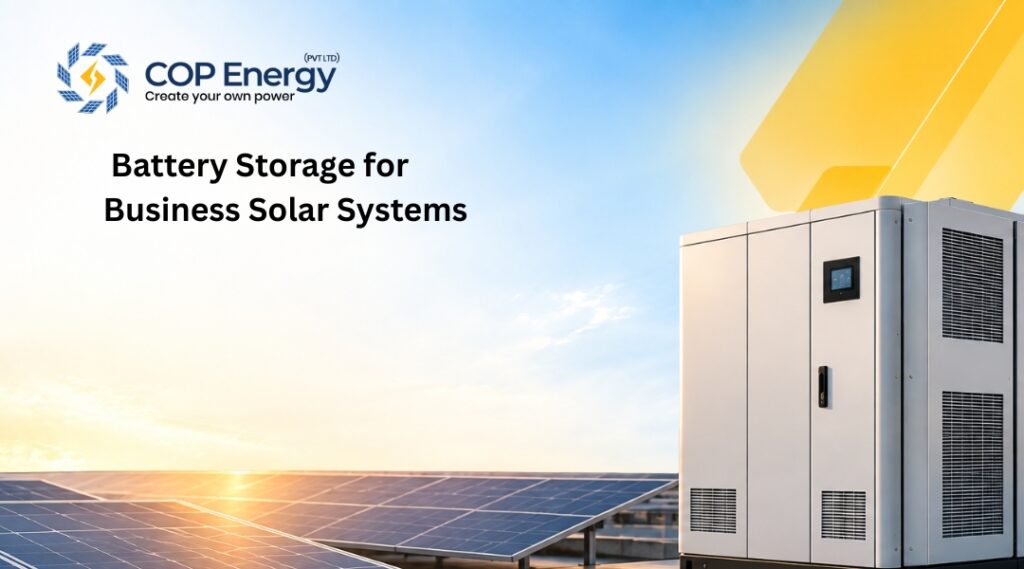
Businesses considering solar-plus-storage can explore COP Energy’s Battery Energy Storage System Solutions .
Solar PPA vs Buying a Solar System
Businesses often compare a solar power purchase agreement with direct ownership of a solar system.
| Factor | Solar PPA | Direct Solar Ownership |
|---|---|---|
| Upfront Investment | Potentially lower | Higher |
| Asset Ownership | Usually developer/project structure | Business owns the system |
| Maintenance | Often managed by project owner | Business responsibility or outsourced |
| Long-Term Control | Contract dependent | Greater direct control |
| Project Scale | Can provide access to larger projects | Depends on available land/roof |
The better option depends on the company’s financial position, electricity demand, facility ownership, risk tolerance and long-term energy strategy.
What Is the Cost of a Solar PPA in India?
There is no universal solar PPA price in India. The effective cost depends on project, electricity-system and contractual factors.
Solar Project Factors
- Project size
- Solar irradiation
- Land cost
- Equipment cost
- Financing cost
- Project location
- Plant performance
Electricity-System Factors
- Transmission charges
- Wheeling charges
- Open-access charges
- Banking charges
- Cross-subsidy surcharge
- Additional surcharge
- Applicable taxes
Contract Factors
- PPA duration
- Tariff structure
- Escalation
- Minimum purchase requirements
- Payment security
- Performance guarantees
Solar PPA ROI and Business Savings
A PPA’s financial benefit should be evaluated against the customer’s existing electricity costs.
A simplified assessment can compare:
VS
PPA Energy Cost + Applicable Charges
Businesses should consider:
- Current grid energy tariff
- Solar PPA tariff
- Open-access charges
- Banking costs
- Transmission and wheeling costs
- Taxes
- Other applicable charges
Actual savings depend on project-specific and state-specific conditions. A professional financial model should therefore be prepared before signing a long-term agreement.
Solar PPA Due Diligence Checklist
Technical Due Diligence
- Solar project capacity
- Technology
- Expected generation
- Plant availability
- Equipment warranties
- Performance guarantees
- Grid connectivity
Financial Due Diligence
- PPA tariff
- Escalation
- Total delivered cost
- Payment terms
- Security requirements
- Termination payments
- Taxes and statutory charges
Regulatory Due Diligence
- Open-access eligibility
- State regulations
- Connectivity
- Wheeling
- Banking
- Surcharges
- Renewable-energy compliance
- Applicable approvals
Legal Due Diligence
- Contract duration
- Default clauses
- Change in law
- Force majeure
- Termination
- Dispute resolution
- Assignment
- Insurance
Solar PPA vs Rooftop Solar
A business with sufficient roof space may compare a PPA against installing and owning its own rooftop solar system.
Rooftop Solar Advantages
- Direct asset ownership
- Potentially greater control
- Long-term electricity savings
- On-site generation
Rooftop Solar Challenges
- Upfront investment
- Maintenance responsibility
- Roof limitations
- Structural considerations
Solar PPA Advantages
- Potentially lower upfront investment
- Developer-managed asset in many structures
- Access to larger off-site projects
- Contract-based energy procurement
Solar PPA Challenges
- Long-term contract
- Less asset ownership
- Regulatory dependencies
- Contractual obligations
🔵 Internal Link – Commercial Solar
If your business is considering direct solar ownership, explore Commercial & Industrial Solar Solutions from COP Energy.
Who Should Consider a Solar PPA?
Solar PPAs can be particularly relevant for businesses with substantial and predictable electricity consumption.
- Manufacturing companies
- IT companies
- Data centers
- Warehouses
- Hotels
- Hospitals
- Shopping malls
- Educational institutions
- Large offices
- Industrial facilities
- Commercial buildings
Solar PPA for Manufacturing Companies
Manufacturing facilities often have substantial electricity requirements.
A commercial solar PPA can potentially help manufacturers:
- Procure renewable electricity
- Improve energy-cost visibility
- Support sustainability targets
- Reduce dependence on conventional electricity
- Explore larger renewable-energy projects
Energy-intensive manufacturers should evaluate the complete delivered renewable-electricity cost rather than considering only the generation tariff.
Solar PPA for Data Centers
Data centers require highly reliable electricity around the clock.
A solar PPA can support renewable-energy procurement, but solar generation alone does not provide continuous 24/7 electricity.
Data-center operators may therefore evaluate combinations of:
Solar PPA + Battery Energy Storage
Battery storage can potentially complement renewable energy PPAs.
Businesses considering a solar-plus-storage arrangement should evaluate:
- Battery capacity
- Power rating
- Charging/discharging profile
- Battery degradation
- Replacement assumptions
- Energy-management system
- Applicable tariffs
- Potential savings opportunities
🔵 Internal Link – Battery Energy Storage
Learn more about Battery Energy Storage System Solutions for commercial and industrial applications.
🔵 Internal Link – EV Charging
Businesses developing renewable-energy infrastructure can also explore EV Charging Solutions from COP Energy.
Authoritative Resources for Solar PPA Regulations in India
Because solar PPA regulations, open-access requirements and electricity-sector rules can change, businesses should refer to official government and regulatory sources.
🟢 External Link – Ministry of Power
Review the Ministry of Power – Electricity Rules and Green Energy Open Access resources.
🟢 External Link – CERC
Businesses can review CERC Current Regulations for current central electricity-sector regulations.
🟢 External Link – Renewable Energy Tariff Regulations
Refer to CERC Renewable Energy Tariff Regulations, 2024 for the applicable regulatory framework.
🟢 External Link – Renewable Energy Bidding
Learn more through the CERC Renewable Energy Bidding Guidelines .
Explore More Renewable Energy Solutions
Frequently Asked Questions About Solar PPA in India
1. What is a Solar Power Purchase Agreement?
A Solar Power Purchase Agreement is a contract under which a buyer agrees to purchase electricity generated by a solar project according to agreed commercial and contractual terms.
2. How does a solar PPA work in India?
A solar developer develops or operates a project and supplies electricity to a buyer under a contractual arrangement. Depending on the structure, the project may be on-site or off-site.
3. Is a solar PPA better than buying solar panels?
Neither option is automatically better. A solar PPA can reduce the need for direct asset investment, while ownership can provide greater control over the solar asset.
4. How long does a solar PPA last?
PPA duration is contract-specific and can be long-term. Businesses should evaluate the contract period against expected electricity demand and their long-term strategy.
5. What determines the solar PPA price?
The effective price can depend on project costs, financing, solar resource, location, PPA duration, tariff structure, transmission and wheeling charges, open-access charges, taxes and other applicable costs.
6. Can small businesses use solar PPAs?
Eligibility depends on the procurement structure and applicable regulations. Green open-access eligibility and other requirements should be checked for the specific state and project.
7. What is an open-access solar PPA?
An open-access solar PPA generally involves procuring renewable electricity from a project that is not necessarily located at the customer’s premises.
8. Can a solar PPA include battery storage?
Yes. Renewable-energy procurement can be structured around projects incorporating energy storage, depending on the project and contractual arrangement.
9. What are the main risks of a solar PPA?
Important risks include long-term contractual obligations, regulatory changes, generation performance, payment conditions, curtailment, open-access charges, change-in-law provisions and termination liabilities.
10. Should a business sign a solar PPA without legal advice?
A long-term solar PPA agreement can have significant financial and legal implications. Businesses should obtain appropriate technical, financial, tax and legal advice before signing.
Conclusion
A Solar Power Purchase Agreement (PPA) in India can provide businesses with another route to access renewable electricity without necessarily owning the complete solar-generation asset.
For companies with significant electricity consumption, a well-structured solar PPA can support renewable-energy procurement, long-term energy planning and sustainability objectives.
However, the headline solar tariff should never be the only factor considered. Businesses should evaluate the total delivered cost of electricity, including applicable open-access, transmission, wheeling, banking, surcharge, taxes and other charges.
Companies should also carefully examine contract duration, generation obligations, payment security, curtailment, change-in-law provisions, termination conditions and regulatory risks.
India’s evolving green-open-access framework and renewable energy regulations are creating additional pathways for businesses to participate in renewable-energy procurement. At the same time, the integration of solar power, battery energy storage and firm renewable energy is expanding commercial energy strategies.
This article is provided for general educational and informational purposes only. Solar PPA pricing, eligibility, open-access charges, regulations, taxes and contractual requirements may vary depending on the state, project and electricity consumer.
Businesses should obtain independent technical, financial, tax and legal advice before entering into a long-term solar power purchase agreement.
Explore Renewable Energy Solutions With COP Energy
Looking to evaluate solar power procurement, commercial solar or battery energy storage for your business?